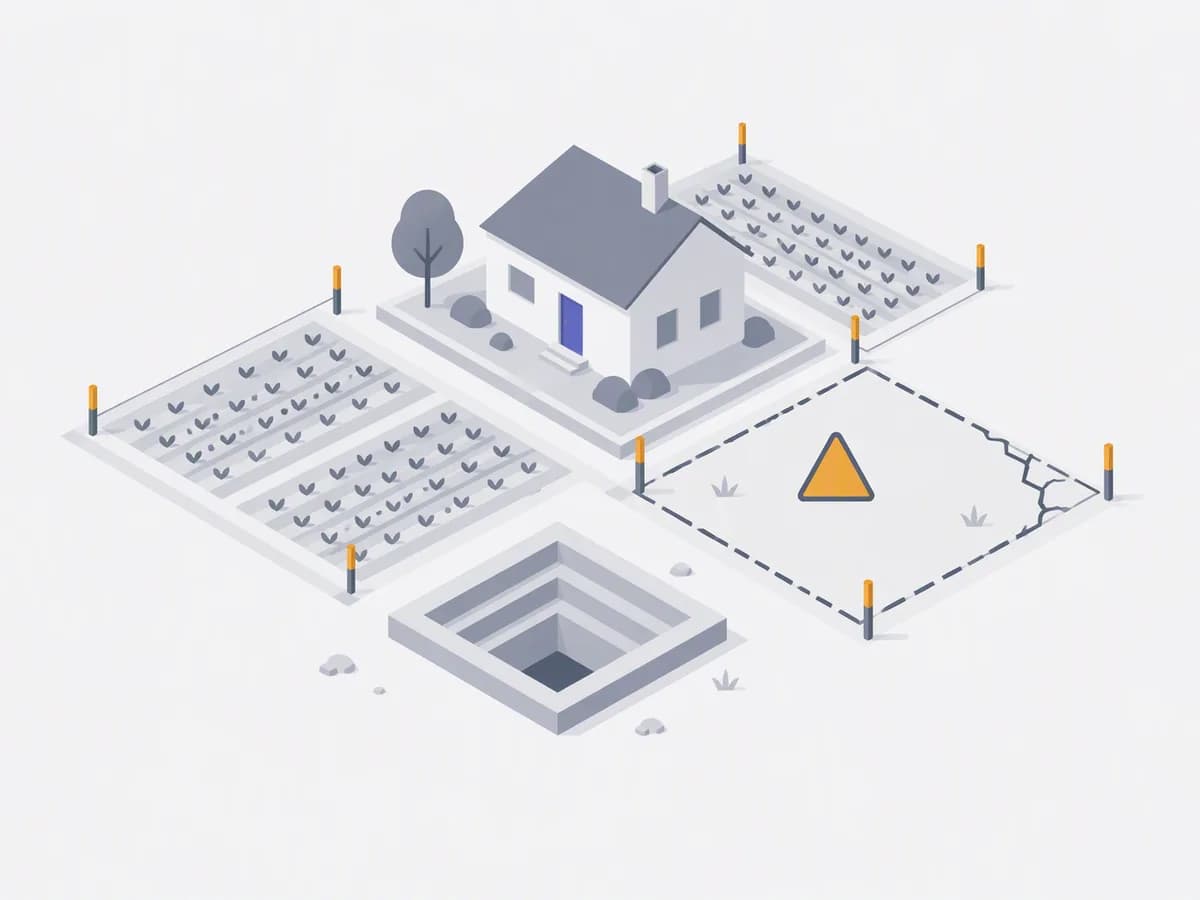
Agricultural land conversion in Gujarat: plot buyer risks
NA permission is only one part of checking whether a Gujarat plot can legally be used for housing or other non-farm purposes.
Who this affects
Worth a read
Read this if you are buying, selling or marketing small plots carved from agricultural land in Gujarat and need to verify NA/conversion status.
- Buyers
Verify NA order, updated revenue entries, approved layout, clear title and GujRERA status before buying plotted agricultural land.
- Developers
Ensure NA, planning approvals, premium payments and RERA registration (if required) are obtained before marketing plots.
- Lawyers & registrars
Check 7/12, 8A, VF-6, NA order, mutation history, encumbrance and Jantri values when advising or registering deals.
- Owners
Follow NA procedure, pay any premium and update revenue and planning records before subdividing or selling plots.
Signals in this story
- Political
- Financial
- Legal
- Regulatory
- Local
Strong legal/regulatory focus on Gujarat NA (section 65/66), RERA and revenue records; significant financial signals from premiums, Jantri and stamp duties.
In Gujarat, a plot carved from agricultural land is safer only after buyers verify NA permission, updated land records, title, layout approval, planning permission and RERA status where applicable. An “NA applied” or “future NA” claim does not itself prove that the plot can be legally built upon or freely resold.
AI-assisted, published after automated editorial checks
Key takeaways
- NA permission changes permitted land use; it does not prove title by itself.
- Check 7/12, 8A, VF-6 entries, NA order and the approved layout together.
- Agricultural-land purchase restrictions can affect buyers before conversion is complete.
- Jantri helps valuation and stamp checks, but it is not the same as NA approval.
- For plotted projects, verify GujRERA registration where the project is covered.
What agricultural land conversion means in Gujarat
In Gujarat property language, agricultural land conversion is commonly called NA permission. It means permission to use land recorded for agriculture for a non-agricultural purpose, such as housing, shops, industry or another approved use. The Revenue Department’s NA procedure is linked to section 65 of the Gujarat Land Revenue Code, 1879, and the state’s online revenue services include an application for NA permission under that provision.
For plot buyers, the key point is that NA permission is not the same as ownership. It also is not the same as a sanctioned layout, building plan, town planning permission, RERA registration or a clear title certificate. It only deals with permission to use the land for a non-farm purpose under the revenue law. Other authorities may still regulate zoning, roads, open spaces, building height, access, services and project disclosures.
The risk is higher where a seller markets small plots carved out of a larger survey number. The revenue record may show the land as agricultural. The plotted layout may not have been approved. The seller may say conversion is “in process” or “will be done after booking”. Buyers generally should treat such statements as incomplete unless the actual NA order, approved plan and updated revenue entries can be verified.
Step-by-step process in broad terms
- The landholder or lawful occupant applies for permission. The 2008 Revenue Department procedure says the applicant must be the legal holder or occupant, and where there is more than one holder, the application has to be made jointly.
- The application is made to the competent authority for the area. The 2008 procedure separates authority by location, such as municipal corporation and urban development authority areas, smaller municipalities and certain rural areas.
- The authority checks the supporting material. The same procedure says evidence listed with the application has to be verified before a decision is taken.
- If the land has restrictions, the applicant may need separate permission or premium-related approval. Gujarat’s iORA service list includes applications for premium permission, new and indivisible tenure land, section 43-related premium matters, and NA permission.
- After permission, the land record should reflect the changed position through the revenue record system. Gujarat’s AnyRoR and e-Dhara services provide rural record-of-rights information, including survey number details, khata details and VF-6 mutation entries.
- For a plotted scheme, conversion should be read with planning approvals. The Town Planning and Valuation Department explains that development control rules regulate permitted land use, plot subdivision, open spaces, parking and related development conditions.
- Where the project falls under RERA, the promoter’s project registration and disclosures should be checked on the Gujarat RERA portal. The national RERA portal describes the law as a transparency and buyer-protection framework and refers to mandatory registration thresholds for real estate projects.
Documents buyers usually check
The first set is the revenue record. This normally includes the latest 7/12 extract, 8A or khata record, VF-6 mutation entries and the survey or block details. AnyRoR is the state-backed system used for viewing rural land records in Gujarat, and district pages describe it as covering village land records across the state.
The second set is the conversion file. This includes the NA order, the application reference, any condition attached to the order, and proof that required premium, conversion tax or other government demand has been dealt with. If the NA order permits a specific purpose, a plot advertised for a different use carries a separate risk.
The third set is the title and registration record. Buyers generally look at prior sale deeds, inheritance or partition documents, Index-2, encumbrance information and mutation history. The Gujarat stamps and registration website lists online services for encumbrance certificate, Index-2 copy, certified document copy, Jantri value and document registration.
The fourth set is the planning record. For plotted developments, this means the approved layout, road access, zoning or F-form where relevant, development permission and later building permission. The state’s development planning information explains that development control covers land use, subdivision, open spaces, parking and other planning matters.
The fifth set is the project disclosure record. If a plotted development is within RERA’s registration requirement, buyers generally verify the GujRERA project entry, promoter name, land details, approvals uploaded and completion commitments.
Fees and timelines
NA conversion is not a fixed-price private formality. Government dues depend on the land, location, tenure, purpose and applicable revenue orders. Where premium is involved, the iORA service list shows separate online routes for premium permission and combined premium-plus-NA permission in some cases. Buyers should be cautious when a seller gives a single verbal amount without showing the government demand or receipt.
Jantri is also relevant, but it should not be confused with conversion permission. The Revenue Department’s Jantri page links to the latest Jantri rate, and the stamps department’s Jantri guidance explains valuation categories for land and construction. Jantri usually affects valuation, stamp duty and market-value checks; conversion dues are governed by the applicable revenue mechanism.
On time, the 2008 NA procedure says the authority must communicate its decision within the legal outer period of three months. In practice, timing can depend on title clarity, missing papers, objections, tenure restrictions, planning remarks and whether premium or other permission is involved. An “applied for NA” status is therefore not the same as completed conversion.
Common problems in plot purchases
A frequent problem is buying a paper plot before the mother land is converted. The buyer may receive an agreement for a small area, but the revenue record still shows one agricultural survey number. That can create difficulty in mutation, subdivision and later resale.
Another issue is agricultural-land purchase eligibility. Gujarat’s iORA service list includes applications for permission to purchase agricultural land under tenancy-law provisions. This shows that buying agricultural land is not the same as buying an ordinary urban plot. A buyer who is not eligible, or who buys without the required permission, may face title and mutation objections.
Some lands carry old tenure conditions, tenant-related entries, government grant conditions, tribal-area restrictions, road reservations or town-planning deductions. These may not be visible in a brochure. They usually appear in revenue entries, prior orders, planning records or collectorate files.
Unauthorised non-farm use can also trigger enforcement. The Ahmedabad district page for the NA branch describes action under section 66 of the land revenue law for non-agricultural use without permission. The Surat district page refers to penalties, removal of construction and action for breach of conditions attached to NA permission.
How buyers can verify the position
Verification starts with matching the land on the ground with the records. The survey or block number in the sale papers should match the 7/12, 8A, VF-6 entries, NA order, layout plan and RERA record, if any. A mismatch in village name, survey number, sub-plot number or area should be treated as a red flag.
The next step is to check whether the NA order is final, conditional or limited to a particular use. Buyers generally compare the order with the proposed use, such as residential plotting, weekend homes, commercial units or industrial sheds. It is also useful to see whether the revenue record has been updated after the order.
Planning verification is separate. Buyers usually verify the approved layout with the local planning authority, municipality, panchayat or urban development authority, depending on the area. The state town planning material makes clear that development plans and control regulations deal with land use and subdivision, so a revenue conversion alone does not answer all building questions.
Finally, project verification matters. The GujRERA portal allows searches of projects, agents, complaints and registrations. If the seller is marketing a plotted project that should be registered, the RERA record helps buyers compare the advertisement with the official disclosures. It is usually advisable to verify doubtful papers with the sub-registrar, revenue office, planning authority or a property lawyer before relying on them.
What this means for buyers and owners
Plot sales on the edge of cities can look simple because the land is visible, fenced and divided on the ground. The legal position is often less simple. A buyer may pay for a “farmhouse plot”, “weekend plot” or “future NA plot” without checking whether the revenue record still treats the land as agricultural. That creates risk at several levels: the sale may face agricultural-land restrictions, the layout may not match an approved plan, later construction may be blocked, and resale or bank finance may become difficult. The safer way to understand such land is to treat conversion as a chain of permissions, not as one stamp on one paper.
Frequently asked questions
- Can a buyer build on agricultural land in Gujarat after signing an agreement?
- Not merely because an agreement is signed. Agricultural land usually needs the relevant NA permission before non-farm use. Building also needs planning or local authority approval where applicable.
- Is an NA order enough to buy a plotted scheme?
- It is important, but not enough by itself. Buyers generally check title, mutation entries, layout approval, road access, development permission and RERA status where the project is covered.
- What does “NA applied” mean in a plot advertisement?
- It usually means the conversion request has been filed or is claimed to be filed. It does not mean permission has been granted. Buyers generally verify the application status and wait for the actual order before treating the land as converted.
- Where can Gujarat land records be checked online?
- The AnyRoR and e-Dhara systems provide rural land-record information such as survey details, khata details and VF-6 mutation entries. For registered-document information, the stamps and registration department provides services such as Index-2 and encumbrance certificate copies.
- Does RERA cover every plotted land sale in Gujarat?
- No. RERA applies where the project meets the legal conditions for registration. If a plotted development is covered, the GujRERA portal can be used to check the project, promoter, approvals and disclosures.
Sources
We summarise published reporting in our own words and link to the original. Publishers can ask for a correction or removal at editor@landandlaw.in. We act within 48 hours. Editorial policy
General information only. This is not legal advice; consult a qualified property lawyer for your situation.
Need a property report?
Get a comprehensive title search report powered by LegiScore.
Powered by LegiScore Trusted by homebuyers, lawyers and lenders
Related reading

Deed Shows 1200 sq ft, Plot Measures 1150: Does Your Title Have a Defect?
Property Risks 23 Sept 2026
9 min read
Worth a read for Buyers, Sellers

A RERA-Registered Flat May Still Stand on Land With a Defective Title
Property Risks 13 Sept 2026
11 min read
Worth a read for Buyers, Owners

Loan Declined on a Legal Opinion? How to Trace the Title Defect
Property Risks 8 Sept 2026
10 min read
Worth a read for Buyers, Owners

Flat With No Completion Certificate: How Dangerous Is It to Buy?
Property Risks 27 Sept 2026
13 min read
Worth a read for Buyers, Owners