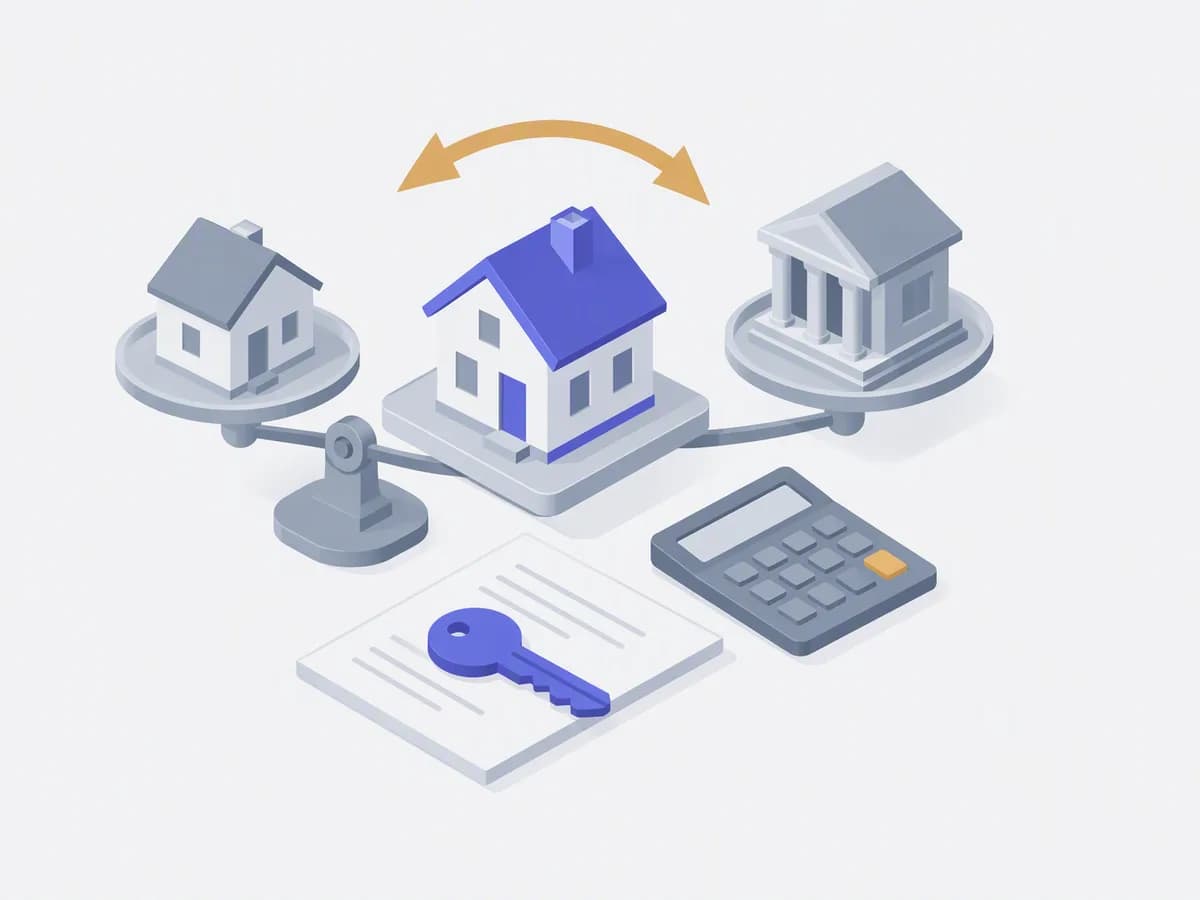
Why Indian Property Needs an AAA-to-C Credit Rating, Like Bonds Have
CRISIL grades bonds, so why not grade properties? See why an AAA-to-C rating scale could become the standard for real estate due diligence in India.
Who this affects
Worth a read
Read this if you buy, invest in or lend against residential or commercial property and want standardized legal/compliance risk metrics.
- Buyers
Helps compare properties objectively with AAA–C grades so buyers can assess legal and compliance risk before purchase.
- Lenders
Ratings could determine loan-to-value and NPA risk assessment for banks and NBFCs using quantifiable risk bands.
- Investors
Enables portfolio allocation across AAA–C properties and clearer risk-return trade-offs for multi-property investors.
- Lawyers & registrars
Standardized ratings would commoditize due diligence and reduce reliance on narrative legal opinions, affecting traditional practices.
Signals in this story
- Political
- Financial
- Legal
- Regulatory
- Local
Strong financial signal: the piece frames ratings as directly influencing lending, LTVs and NPA risk, with secondary legal and regulatory implications.
Before putting money in a corporate bond or a fixed deposit, you look at its CRISIL rating. Before a mutual fund, you look at the credit quality of the fund house. To judge a company's financial strength, you turn to ICRA, CARE or Fitch.
A property worth crores is often the biggest purchase of a person's life. Yet nothing tells you whether it is an AAA asset or a risky C-grade one. No standard rating exists.
That gap in Indian real estate has cost buyers, banks and investors enormous sums through disputes, NPA write-offs and legal fights. The remedy is a standard credit rating for property, copied from the way financial instruments are graded: precise, open and easy to compare.
The Logic of Credit Ratings (CRISIL and ICRA as Models)
Agencies such as CRISIL, ICRA and CARE solve a plain problem. How can anyone judge risk fairly without reading a 500-page prospectus for every investment?
They use a common scale:
- AAA: the highest safety and the lowest risk of default
- AA: high safety and very low credit risk
- A: adequate safety and low credit risk
- BBB: moderate safety and moderate credit risk
- BB and lower: speculative and high risk
Measurable factors such as the debt-to-equity ratio, steadiness of cash flow, sector risks and quality of governance drive the grade. One short code then lets an investor set a Tata bond beside an Adani bond and a government security at a glance.
Standardisation, more than assessment, gives ratings their strength. A BBB bond from one agency can be compared with a BBB bond from another. The shared language lets markets work efficiently.
The Reasons Property Still Has No Standard Rating
Real estate is India's second-largest asset class after gold, and for decades it has had no standard rating. What explains that?
Scattered paperwork. Bonds come with a uniform prospectus. A property involves 15+ kinds of documents in different government offices: sale deeds with sub-registrars, revenue records at tahsil offices, litigation records in courts and encumbrances with registration departments.
Differences between states. Land laws, revenue systems and registration steps vary from state to state. A rating model that fits Maharashtra may not fit Telangana or West Bengal without changes.
Closed doors and gatekeeping. Lawyers and agents have long gained from holding information others lack. A standard rating would make due diligence a commodity and reduce fees, which threatens traditional practice.
No central database. Credit bureaus such as CIBIL and Experian hold loan histories in one place. India has no single national property registry. Title records, mutation data and litigation histories remain in disconnected silos.
Real estate resisted standardisation because complexity paid the intermediaries. Technology now puts complete property intelligence within reach, and that becomes the base for standard ratings.
Trouble with Opinions That Rest on Individual Judgment
Today a commissioned legal opinion on a property is a narrative report of 20-30 pages. One lawyer concludes that the title is marketable with minor defects. Another, looking at the same property, says the title is not clear because of succession issues.
Such subjective assessments cause several problems:
No comparison possible. Is marketable with minor defects better or worse than clear title with encumbrance risk? There is no shared measure.
Severity left unclear. Opinions seldom put numbers on risk. A property with 2 court cases and another with 12 may both be called litigated, with no sign of how serious each is.
Pull of client relationships. A lawyer on a bank's retainer may be tempted to pass deals to keep the business. Independent verification has a different set of incentives.
Time and cost. Legal opinions cost Rs. 5,000 to Rs. 50,000 and take 7-15 days. Comparing several properties before shortlisting becomes impractical, so buyers choose first and verify afterwards, which reverses the sensible order.
The market needs something that rates properties before a purchase decision, and does more than verify them after the commitment is made.
A Property Rating Scale from AAA to C
A credit rating for property applies the logic of financial ratings to real estate. Rather than phrases like marketable title or clear title, you get a precise grade:
- AAA: excellent title, no encumbrances, no litigation, full compliance and verified revenue records
- AA: strong title, only minimal past encumbrances (all released) and no active litigation
- A: good title, small gaps in the chain (less than 5 years old), resolved litigation and minor compliance gaps
- BBB: adequate title, moderate chain gaps (5-15 years) and closed litigation with no appeal risk
- BB: below average, with major chain gaps, pending litigation of low impact and compliance problems
- B: high risk, with a broken title chain, active litigation that threatens possession and major compliance violations
- C: very high risk, with disputed ownership, court-attached property and illegal construction
Each grade stands for a measurable band of risk. A bank lending against an AAA property knows its NPA risk is below 0.5%. A buyer of a BB property knows that higher legal risk is the price of a possible discount.
Five Risk Dimensions Behind a Property Rating
A thorough rating looks at five independent areas of risk:
1. Soundness of the Title Chain
Here the question is whether ownership history is unbroken and can be verified. The rating engine looks at:
- Whether the chain is complete, covering 13 or 30 years depending on property type
- Gaps or missing links in transfers of ownership
- Unregistered dealings, or agreements to sell with no final deed
- Power of attorney transactions where the principal was not verified
A property with a clean registered title chain of 30 years earns AAA here. One with 2 missing links in the last 13 years could earn BBB.
2. Encumbrance Position
This dimension follows financial liabilities and charges on the property:
- Live mortgages or liens, as shown on the encumbrance certificate
- Mortgages that were released, with proper discharge papers
- Hypothecations, pledges or equitable mortgages
- SARFAESI notices or attachment orders
A property free of encumbrances gets AAA. One with a single mortgage released 5 years ago could get AA. A property with a live unpaid lien gets C.
3. Litigation Risk
Court cases and legal disputes linked to the property are weighed here:
- Civil suits still alive, such as partition, title dispute and injunction
- Criminal cases that involve the property or its owners
- Appeals or revision petitions that are pending
- The status of decrees and the risk in executing them
No pending cases at all means AAA. One closed succession case with no appeal could mean A. A property under an active injunction gets C.
4. Regulatory Compliance
This tests whether the property obeys state and local rules:
- Approved building plans and an occupancy certificate
- RERA registration, where it applies
- Environmental clearances, where needed
- Record of property tax payments
- Violations, unauthorised construction or demolition notices
Full compliance gets AAA. Small tax arrears could bring AA. Unauthorised construction with a municipal notice gets B or C.
5. Accuracy of Revenue Records
Here the property is validated against government land records:
- Agreement between the sale deed description and revenue records (pahani, 7/12, khatauni)
- Mutation status, and whether ownership is updated in government systems
- Land use classification, whether residential, agricultural or commercial
- Flags for prohibited property, such as government land, forest land and water bodies
Fully mutated revenue records matching registered deeds earn AAA. Pending mutation with a clear parent title earns A. Property on prohibited lists gets C.
Who Gains from Property Ratings
Buyers of Property
Instead of trusting a broker's loose assurance (boss, full clear title, no tension), buyers can compare objectively. If Property A is rated AAA at Rs. 1.2 crore and Property B is rated BB at Rs. 90 lakh, the choice becomes a reasoned trade between risk and return.
Ratings also let investors think in portfolios. Someone buying several properties might put 70% of capital in AAA-AA assets and 30% in A-BBB assets that offer higher rental yields.
Banks and NBFCs
Ratings translate straight into loan-to-value (LTV) ratios and interest rates. Banks could offer:
- 90% LTV at 8.5% interest on AAA-rated properties
- 80% LTV at 9% interest on AA-rated properties
- 70% LTV at 9.5% interest on A-rated properties
- No loan, or a risk premium, on BB-rated properties
Pricing then matches credit risk, and NPAs that come from undisclosed title defects shrink.
Developers and Sellers
A developer whose inventory is rated AAA can ask for premium prices and sell faster. A seller holding a verified AA rating can close without long checks by the buyer, so the rating itself becomes a selling tool.
A low rating, by contrast, shows what must be fixed first: clear the pending litigation, get overdue OCs or update revenue records, and only then list the property.
Lawyers and Legal Professionals
Ratings do not displace legal opinions. They support them. A lawyer examining an AAA property can concentrate on structuring the transaction, instead of giving 80% of the effort to basic title checks.
Law firms doing bulk due diligence for banks can triage efficiently: light review for AAA properties, standard scrutiny for BBB, and deep audits for B-rated ones.
Rating, Legal Opinion and Valuation Compared
Buyers often mix up ratings, legal opinions and bank valuations. They differ as follows:
- Purpose. Property rating (LPS): to quantify risk. Legal opinion: to assess marketability. Bank valuation: to estimate price.
- Output. Property rating (LPS): a grade from AAA to C. Legal opinion: a narrative report. Bank valuation: market value in Rs.
- Standardisation. Property rating (LPS): fully standard. Legal opinion: varies with the lawyer. Bank valuation: varies with the valuer.
- Comparability. Property rating (LPS): across properties. Legal opinion: not comparable. Bank valuation: comparable within a locality.
- Turnaround. Property rating (LPS): instant to 24 hours. Legal opinion: 7-15 days. Bank valuation: 3-7 days.
- Cost. Property rating (LPS): free to Rs. 2,000. Legal opinion: Rs. 5,000 to Rs. 50,000. Bank valuation: Rs. 3,000 to Rs. 10,000.
- Typical use. Property rating (LPS): screening before purchase. Legal opinion: final legal clearance. Bank valuation: loan approval.
A full due diligence set contains all three: a rating for the first screen, a valuation for pricing, and a legal opinion for final clearance. The rating is still the first filter, since it shows which properties deserve a deeper look.
For more, see Title Insurance vs Legal Opinion vs LPS Rating and Bank Valuation vs Independent Property Rating.
Where Standardised Property Intelligence Is Heading
As India digitises land records and court systems, property ratings are likely to become as routine as credit scores. Developments to expect include:
Live rating updates. Static reports will give way to ratings that change as new encumbrances or cases are registered.
Ratings tied to price. Property portals will show a rating next to the price, and buyers will filter for AAA-AA only the way they filter for 3 BHK or under 1 crore.
A secondary market for rated property. Institutional investors and REITs will build portfolios from rating profiles, and rated assets will become more liquid.
Insurance linked to ratings. Title insurance premiums will follow the rating, with the lowest premiums for AAA property while high-risk property pays more or cannot be insured.
Regulatory requirements. RERA authorities may soon ask developers for property ratings before a project launches, as issuers of securities must obtain credit ratings.
The direction is plain. Nobody buys a bond without checking its rating, and nobody will buy a property without looking at its LPS score.
How the LegiScore LPS Rating Operates
LegiScore introduced India's first AI-driven Legal Property Score (LPS), a standard AAA-to-C rating that assesses properties along the five risk dimensions above.
The steps are simple:
- Type the property address and document details into the platform
- LegiScore's AI agents pull data from 15+ government sources: sub-registrar portals, revenue offices, eCourts, municipal databases, RERA portals and environmental clearance systems
- The system compares records, finds discrepancies and spots hidden risks that manual reviews miss
- You get an LPS rating (AAA to C) with a detailed risk breakdown over all five dimensions
Your first rating comes with a complete title search report, delivered within 24 hours. Banks and developers who need ratings in bulk can use LegiScore's API to automate their workflow.
Learn your property's legal health by getting your free LPS rating today.
Frequently asked questions
- Does a property's rating change as time passes?
- Yes. A new court case, a registered mortgage or a compliance violation lowers the rating. Resolved litigation or a released encumbrance raises it. Re-rate properties periodically, particularly before resale.
- How do AI ratings compare in accuracy with manual legal opinions?
- AI ratings are broader, since they cross-check many government databases at once, which manual work often cannot afford in time and cost. They are still not legal advice. For final clearance of a deal, combine a high rating with a focused legal opinion.
- Do banks accept LPS ratings when approving loans?
- Acceptance is growing. Several NBFCs and cooperative banks use LPS ratings for first screening and risk-based pricing. Most banks still demand a traditional legal opinion for final approval. The rating speeds things up by marking red-flag properties at the start.
- What does buying a BB-rated property mean?
- It means taking on elevated risk. BB properties often have fixable issues such as pending mutation, small title gaps or closed litigation without appeal risk. If you can bear the risk and the price carries the discount (usually 15-25% below market), it may be a good deal, provided you have legal expertise to cure the defects.
- May developers have a property re-rated after fixing problems?
- Certainly. A developer who clears pending litigation, obtains late OCs or updates revenue records can ask for a re-rating. A better rating can improve marketability and open financing on better terms.
- How does a rating differ from a valuation?
- Valuation estimates market price from location, amenities and recent transactions. Rating measures legal and compliance risk. A prime property can be highly valuable and poorly rated at once because of title disputes. They are two separate measures of quality.
General information only. This is not legal advice; consult a qualified property lawyer for your situation.
Need a property report?
Get a comprehensive title search report powered by LegiScore.
Powered by LegiScore Trusted by homebuyers, lawyers and lenders
Related reading

Documents to verify before buying a resale flat in Goa
Buying & Selling 21 Oct 2026
7 min read
Worth a read for Buyers, Sellers

Mint compares home-loan prepayment with SIP investing for borrowers
Buying & Selling 19 Oct 2026
3 min read
Source: Mint
Worth a read for Buyers, Owners
Loan NOC usually comes only after full repayment, Mint explains
Buying & Selling 19 Oct 2026
2 min read
Source: Mint
Worth a read for Owners, Buyers

Delhi NCR: Leasehold or Freehold? Why It Changes Your Purchase
Buying & Selling 9 Oct 2026
5 min read
Worth a read for Buyers, Lenders