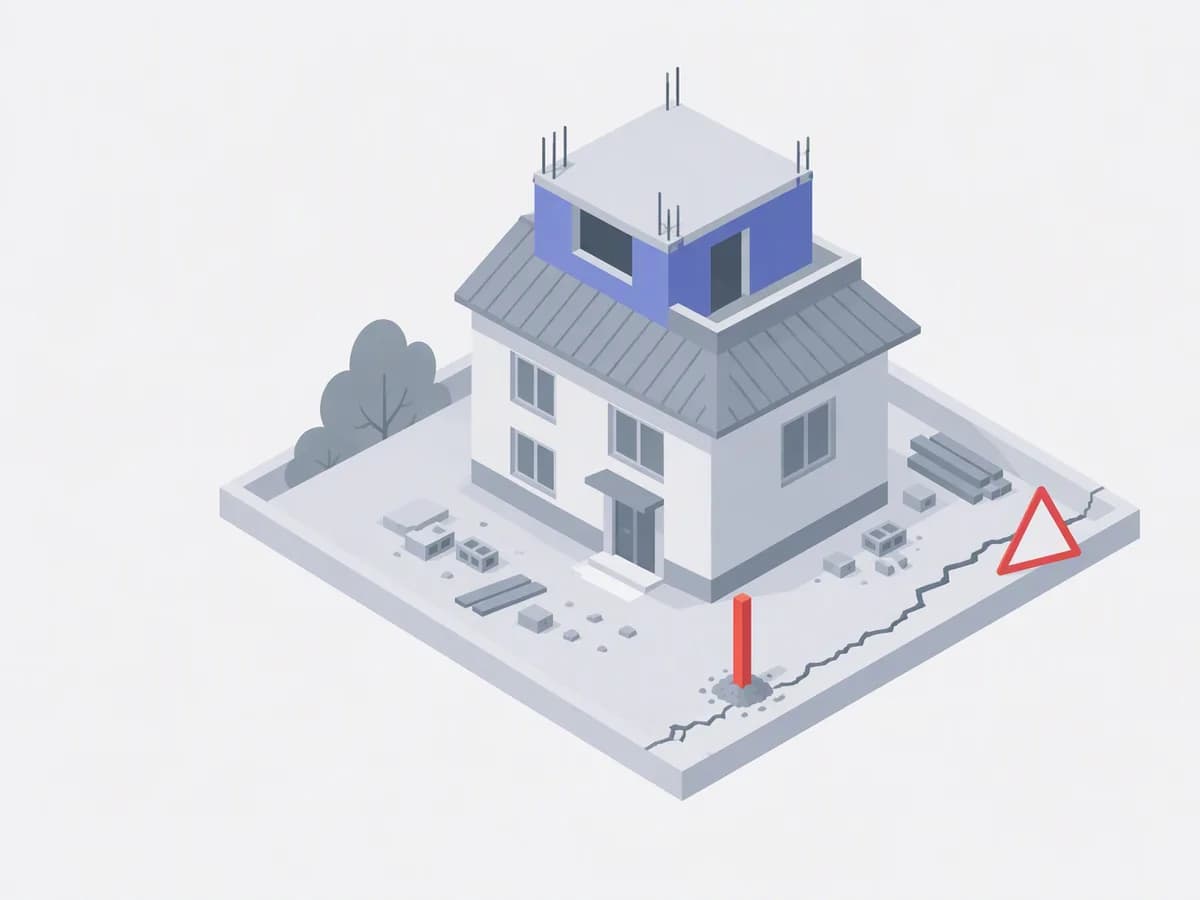
Illegal Construction in India: What Buyers Risk and How to Check
What illegal or unauthorized construction means in India, how to check building approvals, the risk of demolition, regularization options and how buyers can protect themselves.
Who this affects
Worth a read
Read this if you are buying property or advising a buyer and need to check approvals, demolition risk and loan implications.
- Buyers
Explains how unauthorized construction can cause demolition, loan rejection and loss of value for buyers.
- Owners
Details demolition, fines and regularization issues owners may face for violations.
- Lenders
Describes why banks may reject loans or finance only the legal portion of properties with violations.
- Lawyers & registrars
Lists legal and documentation red flags they should check during transactions.
Signals in this story
- Political
- Financial
- Legal
- Regulatory
- Local
Strong financial, legal and regulatory signals: demolition risk, loan rejection and penalties are the main practical consequences described.
Few financial decisions weigh as heavily on Indian families as buying a property. Yet what if the building you are buying includes illegal or unauthorized construction? It happens far more often than people expect. Extra floors added without permission and structures raised with no approval at all run through Indian real estate and put unsuspecting buyers at serious risk.
This guide defines illegal or unauthorized construction and lists the kinds of violations to look out for. It also covers the risks, the way to check building approvals, whether violations can be regularized, and how a buyer can stay protected.
Defining Illegal or Unauthorized Construction
A building or structure counts as illegal (or unauthorized) construction when it was put up without the necessary approvals from the municipal authority, or when it breaks the sanctioned plan, the zoning rules or the building bylaws.
The Legal Framework
Several instruments regulate building construction in India:
- Municipal Acts: each municipality has bylaws that set construction norms
- Development Control Regulations (DCR): they fix FSI/FAR, setbacks, height limits and permitted use
- Town Planning Acts: state laws that govern urban planning and development
- Building Codes: the National Building Code of India (NBC) lays down construction standards
- Environmental Laws: Coastal Regulation Zone (CRZ) rules and forest clearances
- RERA: the Real Estate Regulation and Development Act obliges developers to obtain every necessary approval
When Does Construction Become Illegal?
Construction is held to be illegal or unauthorized in these situations:
- No Building Approval: the building went up without a sanctioned plan from the municipal authority
- Deviation from the Approved Plan: the work departs from the sanctioned plan through extra floors, added area or a changed use
- FSI/FAR Violation: the Floor Space Index or Floor Area Ratio limit is exceeded
- Setback Violation: the building stands too close to the plot boundaries at the front, sides or rear
- Height Violation: the building rises above the maximum height allowed in the zone
- Wrong Land Use: commercial construction on a residential plot, or the other way round
- Encroachment: building on government land, a road, a footpath or someone else's property
- No Occupancy Certificate: people occupy the building without an Occupancy Certificate (OC)
- Environmental Violation: construction in prohibited zones such as CRZ, forest land or water bodies
- Safety Violation: failure to meet fire safety or structural safety norms
Terms You Will Meet
- Unauthorized Construction: built without approval, or in breach of the approval
- Illegal Construction: another name for unauthorized construction, often used the same way
- Encroachment: construction on land that the owner does not own
- Deviation: a variation from the sanctioned building plan
- Building Violations: any breach of building regulations and bylaws
These terms matter when you verify property documents before buying.
Kinds of Building Violations in India
Buyers most often run into the following types of unauthorized construction:
1. A Whole Building With No Approval
This is the worst case, where the entire structure stands without any sanctioned building plan. It is common in:
- Rural and semi-urban areas with weak regulatory oversight
- Unauthorized colonies, that is illegal layouts on farmland
- Slum rehabilitation projects, some of which lack proper approvals
- Old buildings, put up decades ago when rules were loosely enforced
Risk Level: Extreme. Such properties carry the greatest risk of demolition and cannot be legalized.
2. Extra Floors Without Permission
The approval may cover G+2 (ground plus two floors) while the owner has built G+4. This is very common in:
- Old city areas, where land is costly and owners squeeze out all the space they can
- Individual houses, where owners add floors without approval as the family grows
- Small apartment buildings, where builders add floors to raise profits
Risk Level: High. Extra floors are easy to spot, and authorities often single them out in demolition drives.
3. Setback Violations
The building eats into the compulsory setback (open space) that must remain:
- Front setback: the building comes too near the road
- Side setback: too little gap is left next to the neighbouring property
- Rear setback: the building reaches the back boundary
Risk Level: Medium to High. Some cases can be regularized, but buyers still face legal complications.
4. FSI/FAR Violations
The built-up area permitted on a plot is set by Floor Space Index (FSI) or Floor Area Ratio (FAR). Violations take these forms:
- Built-up area above the permitted FSI
- Illegal use of TDR (Transfer of Development Rights)
- Premium FSI used without paying for it
Risk Level: High. FSI violations bring heavy penalties and orders for partial demolition.
5. Land Use Violations
The property is used for a purpose other than the permitted one:
- Commercial use on residential land, such as shops or offices in residential zones
- Industrial use on residential land, such as warehouses or factories in non-industrial areas
- Residential use on commercial land, which is usually less troublesome but still illegal
Risk Level: Medium. These are often regularized through zoning amendments and penalties, but banks may reject loans.
6. Closing Balconies and Terraces
Open balconies, terraces or common areas are turned into closed rooms:
- A balcony becomes a bedroom
- A terrace becomes an extra floor
- Open parking becomes shops
Risk Level: Low to Medium. This is common in apartments, and many cases can be regularized.
7. Basement Violations
Basements are built without approval or used for banned purposes:
- The basement does not appear in the sanctioned plan
- Residential use of the basement, which is often prohibited
- Commercial shops in the basement without permission
Risk Level: Medium. Basements are strictly regulated, and violations are hard to regularize.
8. Encroaching on Public Land
The building spreads onto:
- Government land
- A road or footpath
- A drainage line or water body
- A common area of an apartment complex
Risk Level: Extreme. Encroachments on public land risk immediate demolition, and regularization is not possible.
9. Changes to Apartment Plans Without Approval
Inside apartment buildings, typical cases are:
- Two flats merged into one without approval
- Walls broken or the internal structure altered
- Balconies or windows extended past the building line
Risk Level: Medium. Internal changes may go unnoticed, but they cause problems at resale or when renovation approvals are sought.
10. Environmental Violations
Construction in zones where it is prohibited covers:
- Breaches of the Coastal Regulation Zone (CRZ)
- Building on agricultural land without conversion
- Building close to water bodies or forests
- Construction on wetlands or flood plains
Risk Level: Extreme. Environmental breaches frequently lead to demolition, and regularization is not on offer.
For a broader view of the risks, see our red flags in property documents guide.
Dangers of Buying a Property With Unauthorized Construction
Buying such a property can bring ruinous financial and legal consequences:
1. Demolition
The Worst Fear: municipal authorities can order demolition of unauthorized construction. Complete demolition of large buildings is rare because of political and humanitarian concerns, but partial demolition is common:
- Unauthorized floors pulled down
- Encroached portions removed
- Balcony enclosures broken up
Recent Examples:
- Bangalore (2022-23): BBMP brought down hundreds of buildings that stood on storm water drains
- Delhi (2023): MCD razed several unauthorized commercial constructions
- Mumbai (2022): BMC pulled down unauthorized additions across many buildings
- Hyderabad (2023): GHMC removed illegal structures from government land
Your Loss: you lose the value of the demolished part and face rebuilding costs, where rebuilding is allowed at all.
2. Refusal of a Home Loan
Banks and financial institutions carry out technical due diligence before they sanction a home loan. For properties with unauthorized construction the outcomes are:
- Straight rejection: most banks decline loans on illegal construction
- A smaller loan: some lenders finance only the legal portion
- Higher interest: an approved loan costs more because of the extra risk
- Trouble at resale: future buyers cannot borrow, so your market shrinks
See also the bank requirements for property due diligence.
3. Penalties Under Law and Regulation
Buyers may face:
- Municipal fines: steep penalties for unauthorized construction
- Court cases: proceedings when neighbours complain or authorities act
- Stop-work orders: no renovation or modification is possible
- Utility disconnection: water, electricity and sewage connections can be cut
- Sealing: authorities may seal the premises
4. No Occupancy Certificate
A property with unauthorized construction cannot get an Occupancy Certificate (OC), and as a result:
- Occupying it is illegal
- Permanent utility connections are unavailable
- Registration may be impossible in some states
- Insurers refuse cover
- Resale value drops sharply
5. Problems With Title and Registration
- Registration trouble: some sub-registrar offices will not register a property that lacks building approvals
- Title defects: the title can be clouded by unauthorized construction
- Disputes later: legal heirs or neighbours may challenge the property
- Inheritance difficulties: legal heirs inherit complications
6. Lower Property Value
Properties with unauthorized construction sell at deep discounts:
- 15-40% lower value, depending on how severe the violations are
- A narrow buyer pool, since most serious buyers stay away
- Cash-only deals: banks reject loans, so only cash buyers remain
- A long selling period: such properties take much longer to sell
7. Trouble With Renting
If you plan to let the property:
- Tenants prefer properties that comply with the law
- Commercial tenants must have proper approvals
- Rent is lower because of the perceived risk
- Tenants may face legal action along with you
8. Exclusion From Redevelopment
In cities such as Mumbai, where old buildings are redeveloped:
- Developers turn down buildings with unauthorized construction
- Your building is left out of redevelopment schemes
- Neighbouring buildings are redeveloped while yours stays old
- Your property value stagnates while the area appreciates
9. Insurance Difficulties
- Policy refusal: many insurers will not cover unauthorized buildings
- Claim refusal: even if a policy is issued, claims may be turned down on the ground of unauthorized construction
- Higher premiums: where cover exists, premiums are much higher
10. Stress and Uncertainty
Do not underestimate the mental toll:
- Constant fear of demolition notices
- Stress whenever municipal surveys and demolition drives take place
- Anxiety about falling value and losing the investment
- Family disputes arising from the complications
Weighing all these risks is part of thorough property due diligence.
Checking Whether a Building Is Authorized
Before you buy any property, follow these steps to verify building approvals:
Step 1: Request the Building Approval Papers
Ask the seller or builder for:
- Sanctioned Building Plan: the municipal corporation's approved plan, showing floor plans and elevations
- Commencement Certificate: permission to start building
- Completion Certificate: issued by the architect once construction is done
- Occupancy Certificate (OC): the last approval, which allows people to occupy the building
- Building Plan Approval Number: write down the approval number with its date
Step 2: Confirm With the Municipal Authority
Visit your municipal corporation or check its website:
Online Portals in Major Cities:
- Bangalore (BBMP): look up building plan status on the BBMP portal with the survey number or khata number
- Hyderabad (GHMC): the GHMC website offers a building permission search
- Mumbai (BMC): the BMC Development Plan portal lets you search building proposals
- Pune (PMC): the PMC website provides building permission verification
- Delhi (MCD): see the website of the relevant MCD zone (SDMC, NDMC, EDMC)
- Chennai (CMDA): the CMDA portal covers building approvals
- Kolkata (KMC): the KMC building plan section
What to Confirm:
- The municipal records contain a building approval
- The approved plan agrees with the actual construction
- Approved floors, built-up area and use are what you expect
- Any recorded violations are noted
Step 3: Inspect the Building in Person
Hire a qualified architect or engineer to:
- Compare plans with the building: see if the work follows approved plans
- Measure the built-up area: test compliance with FSI
- Check setbacks: measure distances to the boundaries
- Count floors: confirm the number agrees with the approval
- Inspect structural elements: look for modifications that were not authorized
- Look for encroachments: make sure nothing goes beyond the plot boundaries
Step 4: Look at the RERA Portal (New Projects)
If the project was launched after May 2017:
- Open your state's RERA website
- Search by registration number or developer name
- Look at: — Whether the project is registered — Each approval and certificate uploaded — Building plan approvals — OC status — Violations or complaints on record
Step 5: Ask the Neighbours
Talk to owners of adjoining properties:
- Ask if they know of any building violations
- Find out whether encroachment was ever disputed
- Ask about municipal notices they have received
- See whether earlier owners ran into trouble
Step 6: Look for Notices
Search for:
- Municipal notices, pinned on the property or held in municipal records
- Court cases: search the eCourts portal for litigation on building violations
- Newspaper notices: some authorities print demolition notices in the papers
Step 7: Check Revenue Records
Verify land records to make sure that:
- The land use classification (residential, commercial or agricultural) is right
- The plot area matches the building approval
- There is no encroachment on government land
- Land conversion certificates exist, if the land was originally agricultural
Our guide on revenue records in India has the details.
Step 8: Get Professional Verification
Consider engaging:
- An advocate who specializes in property law, to verify the legal documents
- A licensed architect, for the technical side
- A property verification service, for full due diligence
An AI-powered platform like LegiScore is another route, giving quick and thorough verification.
Signs That Construction May Be Unauthorized
Be alert to these red flags:
- The seller drags his feet over producing building approvals
- The building plan approval dates from long ago (before the 2000s) and was never updated
- Neighbours mention disputes that continue
- The building clearly differs from the approvals claimed
- No Occupancy Certificate is available
- The builder or seller offers a "discount for cash payment" to avoid scrutiny
- The property is sold "as-is" with disclaimers about approvals
- The price is unusually low compared with area rates
Our guide on common property frauds in India lists more warning signs.
Is Regularization of Unauthorized Construction Possible?
Good news: many kinds of unauthorized construction can be regularized, meaning made legal, by paying penalties and getting retrospective approval. Several factors decide whether this works.
About Regularization
Also known as compounding, regularization is how municipal authorities let owners legalize unauthorized construction. The owner does the following:
- Paying compounding fees or penalties
- Obtaining retrospective building approval
- Ensuring that the construction meets safety standards
- Rectifying every violation that can be rectified
Violations That Can Be Regularized
In general, these violations MAY be regularized, depending on the state or city:
Often Regularizable:
- Minor setback violations: slight encroachment into setback space
- Balcony enclosures: balconies that were closed in, when the structure is sound
- Internal modifications: alterations inside that leave the structure untouched
- Minor FSI violations: built-up area slightly above the permitted figure
- Change of land use: commercial use of a residential property, with penalties
- Unauthorized basement: if it meets safety norms
- Minor height violations: height a little over the limit
Rarely or Never Regularizable:
- Encroachment on public land such as roads, drains and government property
- Environmental violations covering CRZ, forest land and water bodies
- Structural safety violations: buildings liable to collapse
- Major FSI violations: area far above what is permitted
- Unauthorized additional floors: floors above what was approved, as a rule
- Agricultural land conversions made without proper conversion orders
- Dangerous structures: buildings that flout fire safety or earthquake norms
What Affects Regularization
- State or City Policy: each state and municipality has its own regularization rules
- Type of Violation: some violations can be compounded and others cannot
- Extent of Violation: minor deviations are easier to regularize than major ones
- Age of the Building: older buildings may get more leeway in some places
- Structural Safety: buildings must meet minimum safety standards
- Neighbours' Objections: a neighbour's complaint can hold up regularization
- Political Will: a new government can change regularization policy
The Regularization Process in General
- File an Application: hand it to the municipal authority along with: — Plans of the building as it stands (as-built drawings) — The original property documents — A structural stability certificate signed by a licensed engineer — Photographs of the construction — An affidavit that admits the violation and promises payment of penalties
- Site Inspection: municipal officials come to the site to check the construction
- Assessment: the authority decides: — Whether the violation can be compounded — The amount of penalty or compounding fee
- Payment: pay the assessed fee or penalty, which can be substantial
- Approval: on approval you get: — A regularized building plan — An Occupancy Certificate where one applies — Municipal records brought up to date
- Timeline: normally 3-12 months, depending on how complex the case is and the backlog
What Regularization Costs
It is not cheap. Compounding fees usually fall in these ranges:
- Minor violations: between ₹100 and ₹500 for each sq.ft of violation
- Moderate violations: ₹500-2,000 for each sq.ft
- Major violations: ₹2,000-5,000+ for each sq.ft
Add:
- Application fees
- Professional fees for the architect and engineer
- Structural audit charges
- Fees for legal consultation
Example: regularizing an unauthorized extra floor of 500 sq.ft might cost ₹5-25 lakhs, depending on the city and how severe the violation is.
Caveats to Remember
- No Guarantee: applying does not mean the application will be approved
- Stay Orders: courts may stay regularization schemes
- Time Limits: regularization schemes often have deadlines
- Changed Rules: a future government may reverse regularization
- Buyer Beware: do not buy an unauthorized property on the assumption that it will be regularized
Regularization Schemes by State
Many Indian states have launched schemes to regularize unauthorized construction. A summary:
Karnataka (Bangalore)
The Akrama Sakrama Scheme:
- It permits regularization of unauthorized construction in Bangalore and other cities
- It applies to buildings put up before specified cut-off dates
- Compounding fees depend on the type of violation and the area
- The scheme has met legal challenges, so check its current status before going ahead
Eligibility:
- Violations up to certain cut-off dates
- The building must be structurally safe
- Encroachments on public land cannot be regularized
Maharashtra (Mumbai, Pune)
Regularization Policy:
- Mumbai and Pune run regularization schemes from time to time
- Minor deviations can be compounded
- Commercial properties pay higher fees
- CRZ violations face strict restrictions
BMC (Mumbai):
- Unauthorized constructions can be regularized within prescribed limits
- Schemes are time-bound with deadlines
- An online application process is available
Delhi
Regularization of Unauthorized Colonies:
- The focus is on regularizing whole unauthorized colonies
- Violations in individual buildings are handled separately by the MCDs
- Policies differ by MCD zone
- Schemes are announced from time to time
Tamil Nadu (Chennai)
Building Regularization:
- CMDA allows regularization of violations in Chennai
- Compounding fees depend on the extent of the violation
- A structural stability certificate is mandatory
- Major violations and encroachments cannot be compounded
Telangana (Hyderabad)
GHMC Regularization:
- Schemes to regularize unauthorized construction come up periodically
- Applications can be made online through the GHMC portal
- Fees depend on the type of violation
- Violations that cannot be regularized face active enforcement
Gujarat (Ahmedabad, Surat)
Voluntary Disclosure Scheme:
- Owners may declare unauthorized construction
- They pay penalties to regularize it
- Specific cut-off dates apply
- Encroachments and major structural violations cannot be regularized
Uttar Pradesh
Relaxation of Building Bye-Laws:
- Several municipal corporations offer regularization
- Each city (Noida, Lucknow, Ghaziabad) has its own scheme
- Application windows are time-limited
- Enforcement gets stricter after scheme deadlines
Other States
Most other states let violations be compounded, but policies differ:
- West Bengal: KMC permits regularization of certain violations
- Rajasthan: Jaipur and other cities run periodic schemes
- Madhya Pradesh: municipal corporations decide case by case
- Andhra Pradesh: regularization schemes exist in Vijayawada and Visakhapatnam
Finding Out Which Schemes Are Open Now
Regularization schemes have deadlines and change often. To learn which are current:
- Visit your municipal corporation's official website
- Look in its "Building Permissions" or "Regularization" section
- Call the municipal helpline
- Consult a local property lawyer
- Watch local newspapers for announcements of schemes
Warning: do not accept the word of a broker or seller who says "regularization will happen soon." Always verify independently.
Demolition Orders: When Authorities Act
Knowing when and how demolition happens helps you judge the risk:
Triggers for Demolition Orders
- Encroachment on Public Land: the top priority for authorities
- Court Orders: courts direct the removal of illegal construction
- Safety Hazards: buildings that threaten to collapse or catch fire
- High-Profile Complaints: cases raised by VIPs or highlighted by the media
- Political Drives: anti-encroachment campaigns
- Environmental Violations: CRZ, lake encroachments, forest land
- Storm Water Drain Encroachments: a major focus in cities with flooding problems
How Demolition Proceeds
- Survey and Identification: the authority identifies the unauthorized construction
- Show Cause Notice: the owner gets a notice to explain
- Hearing: the owner may present the case and documents
- Demolition Order: if the authority is not satisfied, it issues the order
- Appeal Window: usually 15-30 days to appeal
- Final Demolition: if no stay is obtained, demolition goes ahead
Legal Remedies Against Demolition
On receiving a demolition notice:
- Reply at once: answer the show cause notice with all documents
- Seek a stay order: file a petition in the High Court or another appropriate forum
- Prove compliance: show that the construction is authorized or can be regularized
- Apply for regularization: if you are eligible, apply immediately
- Negotiate: in some cases partial demolition may be allowed in place of complete removal
- Claim compensation: if the demolition is wrongful, claim compensation
Grounds on Which to Challenge Demolition:
- The construction is actually authorized, which you prove with documents
- The notice was not properly served
- The demolition order has procedural irregularities
- The violation can be regularized under current schemes
- The action is discriminatory, as similar violations were not demolished
- The principles of natural justice were violated
After a Demolition
- Total Loss: the demolished portion is a complete financial loss
- Debris Removal: the owner must clear debris at his own cost
- Reconstruction: it may or may not be allowed, and needs fresh approval
- Legal Costs: fees spent fighting demolition add to losses
- Property Value: even without demolition, value collapses once the threat arises
Demolition Figures
Large residential buildings are seldom demolished completely, for political and social reasons, but partial demolitions happen often:
- In Bangalore (2022-23) over 15,000 unauthorized structures came down
- Delhi (2023) saw several hundred unauthorized constructions removed
- Mumbai (2022) had hundreds of unauthorized additions demolished
A Reality Check: the rarity of large-scale demolition does not mean the risk is absent. The mere threat of demolition destroys property value and causes great stress.
Home Loans and Unauthorized Construction
Banks and financial institutions follow strict policies on unauthorized construction:
Why Banks Refuse Loans on Unauthorized Construction
- Collateral Risk: if the building is demolished, the collateral is worth nothing to the bank
- Legal Liability: banks do not want to be party to illegal activity
- RBI Guidelines: regulatory rules require due diligence
- Resale Risk: if the borrower defaults, the property is hard to sell
- Reputational Risk: banks avoid being linked to illegal properties
The Bank's Technical Due Diligence
A bank runs thorough checks before it sanctions a loan:
- Paper checks: — The sanctioned plan — Commencement and completion certificates — The occupancy certificate — Approvals for the layout and project
- Inspection of the site: — An in-house technical team or empaneled architect goes to the property — Sets the construction beside the sanctioned plans — Looks for deviations and breaches — Takes photographs and measures
- Legal review: — Bank lawyers read every document — Search for cases or violations still pending — Confirm that title is clear and approvals are in order
- Valuation: — Authorized portions are valued at full market rate — Unauthorized portions get a reduced value or none
What Banks Look For
Green Signals (loan likely to be approved):
- A building plan approval that is valid
- An Occupancy Certificate in hand
- The building follows the approved plan
- Every regulatory clearance obtained
- A clear title backed by proper approvals
Red Flags (loan likely to be rejected):
- No approval for the building plan
- No Occupancy Certificate
- Deviations from the approved plan that can be seen
- Unauthorized additional floors
- Public land encroached
- Legal cases on building violations still pending
- No scope for regularization
Is a Loan Possible for Partly Unauthorized Construction?
In rare cases, banks may consider:
- A loan for the authorized portion only: for example, if the building has 3 legal floors and 1 unauthorized floor, the loan covers the value of 3 floors
- Conditional approval: the owner must regularize before the final disbursement
- A larger down payment: 30-40% in place of the standard 20%
- A higher interest rate: a premium for the added risk
Most banks, though, would rather reject such applications than take on the risk.
Effect on Refinancing and Balance Transfer
If you already own a property with unauthorized construction:
- Refinancing is hard: the new bank will do fresh due diligence
- Balance transfer is refused: banks will not accept an unauthorized property as collateral
- Top-up loans: further loans against the property are not possible
What Buyers Should Do
Before applying for a home loan:
- Verify approvals in advance: check all building approvals yourself
- Get a pre-sanction: apply for in-principle approval so problems appear early
- Be honest with the bank: do not hide information, because it will come out
- Allow for rejection: keep backup financing ready if approvals look doubtful
- Think about loan insurance: PMAY and other schemes need proper approvals
Our detailed guide on property due diligence for home loans has more.
How LegiScore Checks Building Approvals and Compliance
A property verified through LegiScore goes through our AI-powered platform, which runs comprehensive checks on how well it complies with building rules and whether it is authorized:
Our Verification Process
1. Building Approval Verification:
- Look in municipal records for the sanctioned plan
- Confirm the plan's approval number and date
- Cross-check against online municipal databases
- Flag the property when no approval turns up
2. Occupancy Certificate Status:
- Confirm that an OC exists and is genuine
- Note the OC date and the authority that issued it
- Distinguish temporary from permanent OCs
- Flag an OC that is absent or has expired
3. RERA Compliance (new projects):
- Confirm the project's registration on the RERA portal
- Review approvals and certificates uploaded there
- Review how far the project is complete
- Spot any RERA complaints or violations
4. Analysis of the Physical Construction:
- Study property photographs for violations that show
- Set the construction against approved plans, when they exist
- Detect likely setback violations
- Flag extra floors or extensions that are plain to see
5. Search of Legal Cases:
- Look through eCourts for building violation cases
- Check for demolition orders and municipal notices
- Find disputes still running over unauthorized construction
6. Encumbrance Check:
- Read encumbrance certificates for any mention of violations
- See whether municipal authorities registered any charge
- Pick out court orders concerning the property
7. Verification of Revenue Records:
- Confirm how the land is classified for use
- Check whether agricultural land was converted
- Make sure the land records agree with the building approvals
Contents of Our Report
Building Compliance Section:
- Approval Status: whether a sanctioned building plan exists
- OC Status: whether an Occupancy Certificate is available
- Identified Violations: any visible or documented violations
- Regularization Possibility: an assessment of whether violations can be compounded
- Risk Level: a High, Medium or Low rating for building compliance
Compliance Risk dimension: the status of building approvals weighs heavily in this part of your property's LPS Rating:
- AAA to A: approvals complete and no violations found
- B to C: approvals missing, violations found, demolition possible
Practical Recommendations:
- Whether to go ahead with the purchase
- If purchase is advised, at what discount
- Steps to regularize, if that is possible
- Documents to demand from the seller
- Legal precautions to take
Effect on the LPS Rating
Properties with unauthorized construction normally get:
- A low Compliance Score: a major negative effect on the overall rating
- Risk Alerts: shown prominently in the report summary
- A lower rating: it can fall from AA to C or below
- Red Flag Status: marked for buyer caution
Reasons to Use LegiScore for Building Verification
1. Comprehensive Coverage:
- Many databases and sources are checked
- Digital records and physical indicators together
- Government portals, RERA, eCourts and encumbrance records are all covered
2. Fast and Accurate:
- The AI analysis gives results within minutes
- Complex cases get expert review
- Far quicker than traditional verification, which needs weeks or months
3. Professional Guidance:
- A clear assessment of risk
- Recommendations you can act on
- You know exactly what you are getting into
4. Affordable:
- The first rating for your property comes with a full title search report
- Costs much less than several professionals would
- It stops expensive mistakes
5. Transparent Reporting:
- Risk scores that are easy to follow
- Every finding is explained in detail
- Evidence and document references back each point
Unauthorized construction is no place for gambling, so get your free LPS rating today and find out if your property's building compliance is sound.
Best Practices for Buyers
Follow these practices to protect yourself against the risks of unauthorized construction:
Before You Buy
- Verify Building Approvals: — Get copies of all building documents — Verify with the municipal authority independently — Do not rely only on the seller's documents
- Physical Inspection: — Hire a qualified architect or engineer — Compare the actual building with approved plans — Look for visible violations
- Check RERA Status (new projects): — Verify project registration — Review every uploaded document — Check for complaints
- Search for Legal Cases: — Check eCourts for building violation cases — Search for demolition orders — Ask neighbours about disputes
- Get Professional Help: — Hire a property lawyer to review documents — Use property verification services such as LegiScore — Do not skip due diligence to save money
While Negotiating
- Demand Transparency: — Ask the seller directly about violations — Request a warranty on building approvals — Get representations in writing
- Adjust the Price: — If violations exist, negotiate a significant discount — Factor in regularization costs, if possible — Allow for demolition risk and lower resale value
- Contractual Protections: — Include clauses on building approvals in the sale agreement — Specify the seller's liability if violations are found — Keep part of the payment in escrow until verification is done
A Framework for Deciding
Go Ahead Only If:
- All building approvals are in place
- An Occupancy Certificate is available
- No violations are found
- Title is clean and no legal cases exist
Go Ahead With Caution If:
- Violations are minor and can be regularized
- The seller agrees to regularize before the sale
- A large price discount compensates for the risk
- You understand and accept the risks
Stay Away Completely If:
- Major violations cannot be regularized
- There is encroachment on public land
- There are environmental violations
- Multiple legal cases are pending
- The seller refuses to provide documents
If You Have Already Bought a Property With Violations
- Regularize at Once: — Apply for regularization immediately — Do not wait for future schemes — Get a structural stability certificate
- Document Everything: — Keep all correspondence with authorities — Keep records of regularization attempts — Record all expenses
- Take Legal Advice: — Keep a property lawyer on retainer — Be ready to challenge unjust demolition orders — Know your legal rights
- Insurance: — Get property insurance if available — Consider legal expense insurance — Keep an emergency fund for legal costs
- Avoid Further Violations: — Make no more unauthorized modifications — Get approvals for any renovation — Stay compliant from now on
Advice for Sellers With Unauthorized Construction
If you are selling a property that has violations:
- Full Disclosure: both ethics and law require you to disclose all violations to prospective buyers
- Regularize First: try to regularize before selling, which raises the value and widens the buyer pool
- Price Fairly: reflect the violations in your price
- Share Documents: give all documents openly
- Legal Indemnity: be ready to give indemnities in the sale agreement
For comprehensive guidance on verification, read our property document verification guide.
Frequently asked questions
- What if I bought a property without knowing it had unauthorized construction?
- Your options depend on how severe the violations are. For minor violations that can be regularized, apply to the municipal corporation at once and pay the compounding fees. For major violations, consult a property lawyer to assess the demolition risk and consider remedies against the seller if the property was misrepresented. You may be able to claim damages or cancel the sale agreement if the violations were deliberately hidden. Keep a record of all communications and violations, and think about a police complaint for fraud if the seller knowingly sold an unauthorized property without disclosure. Prevention beats cure, so always do thorough due diligence before you buy.
- Will a bank find out if I hide unauthorized construction when I apply for a loan?
- Yes, almost certainly. Banks run rigorous technical and legal due diligence before sanctioning a home loan. Their empaneled architects visit the site, measure the property, compare the construction with sanctioned plans and check municipal records. They also get legal opinions that include verification of building approvals. Hiding unauthorized construction is futile and amounts to fraud, which can bring immediate rejection of the loan, blacklisting by the bank and even legal action against you. If violations come to light after disbursal, the bank can invoke default clauses and demand full repayment. Disclose unauthorized construction honestly, since some banks may still offer a partial loan or suggest regularization before processing your application.
- Is it illegal to buy property in an unauthorized colony?
- Buying there is not technically illegal, but it carries heavy risks: no civic amenities, no municipal services, no proper roads or drainage, trouble getting building approvals, banks that refuse home loans, and property without clear title. Several state governments do launch regularization schemes for unauthorized colonies from time to time, and Delhi's is the best known. Before you buy in one, check whether regularization has been granted, confirm the layout approval status, find out when municipal services will arrive, and ask for a big discount. Consider waiting until regularization is complete instead of buying in the hope of a future scheme.
- What discount should I expect on a property with unauthorized construction?
- The discount depends on how severe the violation is, whether it can be regularized, the location and the market. For minor violations that can be regularized, such as balcony enclosures or small setback deviations, expect 10-15% plus the cost of regularization. For moderate violations such as unauthorized extra floors or FSI breaches, expect 20-35%. For major violations with a high risk of demolition, such as encroachment on public land or environmental violations, expect 40-60%, but consider avoiding them altogether. Also remember that resale is extremely limited (cash buyers only), no home loan is available, and legal expenses may arise. Some violations are so severe that no discount justifies the purchase. Get a professional valuation that accounts for the specific violations before you finalize anything.
- Is it possible to insure a building that has unauthorized construction?
- It is very hard to get full cover. Most insurers either reject applications for unauthorized buildings or offer limited cover with many exclusions. Even when a policy is issued, claims may be refused on the ground of unauthorized construction. Insurers rate risk by legal status, and unauthorized buildings are high-risk. Some may offer basic fire cover but exclude structural damage, third-party liability and demolition losses. If you do get insurance, expect much higher premiums and a clause that lets the insurer cancel cover if violations are found or a demolition notice arrives. Owners of such property should put regularization ahead of insurance: regularize first and then buy full cover.
- How often do regularization schemes succeed in India?
- Success varies greatly by state and city. Generally only 20-40% of applications under regularization schemes are approved, depending on the jurisdiction and the type of violation. Schemes like Karnataka's Akrama Sakrama have had mixed results because legal challenges affected implementation. Delhi's regularization of unauthorized colonies has worked better for whole colonies but is slower for individual violations. Success depends on the type and extent of the violation (minor deviations are approved more often), structural safety compliance (mandatory), applying within scheme deadlines, complete documents, and no encroachment on public land. Even when approval comes, the process normally takes 6-18 months and needs large compounding fees. Do not buy an unauthorized property assuming regularization is certain, since schemes change, face legal challenges or have limited scope. Treat regularization as a possibility and never as a certainty. Protect yourself from the risks of unauthorized construction: before buying any property, verify building approvals, check for violations and learn your legal rights. For comprehensive verification covering building compliance, title chain, encumbrance, litigation and revenue records, get your free LPS rating now. LegiScore helps property buyers make informed decisions with India's first AI-powered legal property score.
General information only. This is not legal advice; consult a qualified property lawyer for your situation.
Need a property report?
Get a comprehensive title search report powered by LegiScore.
Powered by LegiScore Trusted by homebuyers, lawyers and lenders
Related reading

Sale During a Pending Court Case With No Stay: Registered but Risky
Property Risks 22 Sept 2026
9 min read
Must read for Buyers, Owners
Flat With No Completion Certificate: How Dangerous Is It to Buy?
Property Risks 27 Sept 2026
13 min read
Worth a read for Buyers, Owners

Loan Declined on a Legal Opinion? How to Trace the Title Defect
Property Risks 8 Sept 2026
10 min read
Worth a read for Buyers, Owners

Home Loan Title Report: Your Lawyer or the Bank's Panel Advocate?
Property Risks 21 Sept 2026
8 min read
Worth a read for Buyers, Owners