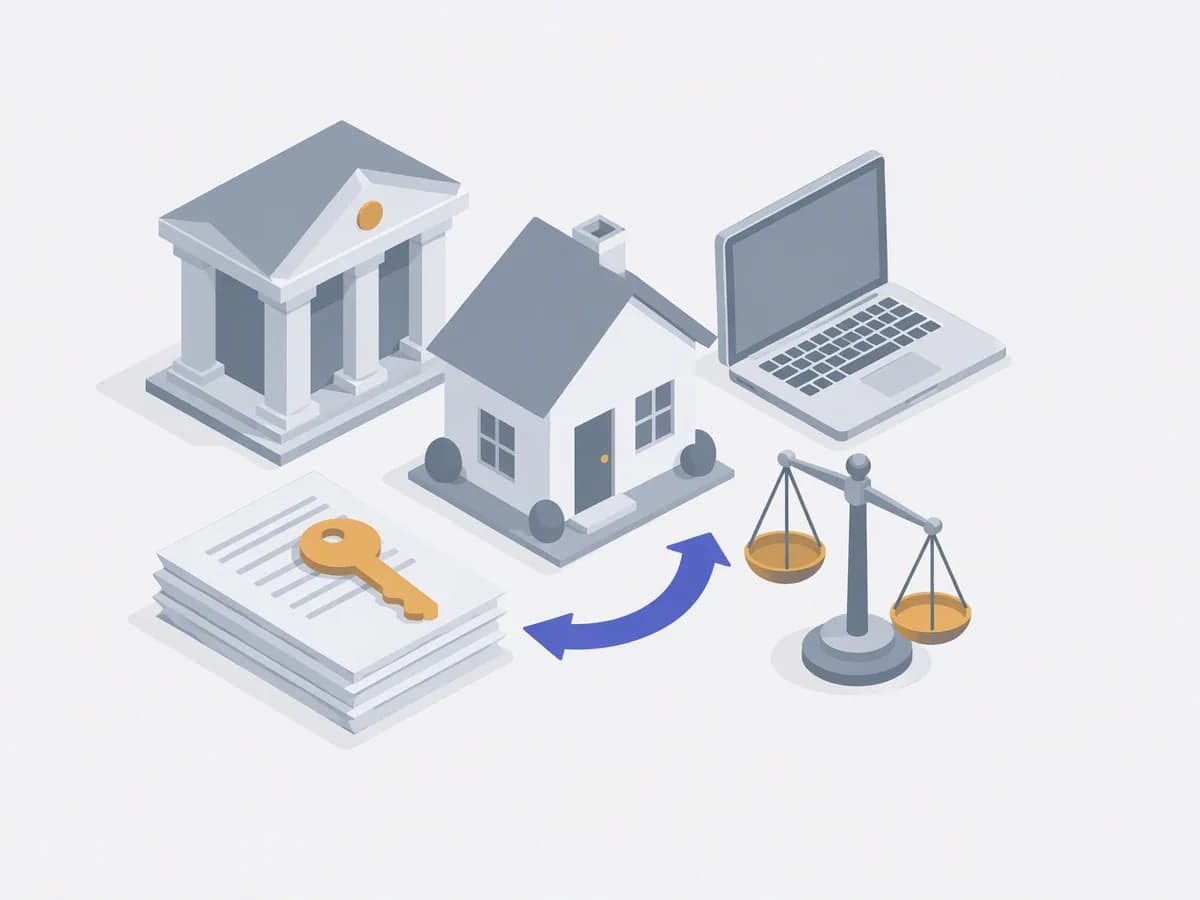
Property Verification for Banks and NBFCs: A Standard Due Diligence Guide
Make property verification for mortgage lending uniform. A compliance checklist, risk controls and a due diligence process for banks, NBFCs and housing finance companies.
Who this affects
Worth a read
Read this if your institution sanctions loans against immovable property or you are an empaneled legal/valuation partner for mortgage checks.
- Lenders
Banks, NBFCs and HFCs must adopt standardized property verification and due-diligence steps to reduce recovery and compliance risk.
- Lawyers & registrars
Empaneled advocates and valuers must perform title searches, EC scrutiny, litigation searches and legal/technical checks.
Signals in this story
- Political
- Financial
- Legal
- Regulatory
- Local
Strong regulatory and legal signals—RBI/NHB guidelines and SARFAESI/legal enforcement risks drive the guide; financial exposure is also high.
Lending against property is the backbone of India's financial sector. Home loans and mortgage-secured advances together make up more than ₹30 lakh crores of outstanding credit. Even so, property checking remains one of the weakest points in how loans are made. Lenders keep taking avoidable losses, from title defects discovered once money has gone out and from defaults that litigation sets off, when due diligence was not done properly.
Meeting compliance is just one part of the job for banks, Non-Banking Financial Companies (NBFCs) and Housing Finance Companies (HFCs). What they also need is a framework for verification that is scalable, consistent and easy to defend, and that shields both the institution and its customers. In these pages you will find a structured method for bank property verification, NBFC property checks and mortgage due diligence that meets regulatory expectations and keeps operational risk low.
Who should read this guide
The guide is written for:
- Banks and Scheduled Commercial Banks: retail teams working on home loans, loans against property (LAP) and construction finance
- NBFCs and HFCs: mortgage specialists, affordable housing financiers and vehicle-loan lenders that want uniform property checks
- Credit Risk Teams: underwriters and credit policy staff who assess collateral
- Legal and Compliance Teams: in-house lawyers who ensure that RBI, NHB and SARFAESI norms are observed
- Third-Party Valuation Partners: advocates on the lender's panel, valuers and verification agencies
Does your institution sanction loans backed by immovable property? Then use this guide to build, or tighten, a verification process that stands up to audit, responds to risk and works efficiently.
Risks peculiar to mortgage lending
Lending against property brings risks that other kinds of credit lack:
1. Defective title and disputes over ownership
Borrowers may say that their ownership is clear while the title chain hides defects handed down from earlier owners, such as incomplete sale deeds, unregistered deeds, power of attorney sales made without proper authority, or partition disputes among legal heirs. When such a borrower defaults and the lender moves to enforce its security, the collateral turns out to be worth nothing because of the flawed title.
Example: A ₹40 lakh home loan is secured on a flat in Hyderabad. The borrower defaults, and in the SARFAESI proceedings a cousin of the borrower sues, claiming co-ownership on the basis of an unregistered family partition deed. The auction is put on hold and recovery goes on for years.
2. Encumbrances and liens nobody disclosed
Only registered transactions appear in an encumbrance certificate (EC), so informal loans, unregistered agreements to sell and government dues can escape it. Another lender may hold a mortgage on the property already, or property tax or construction dues may be outstanding, and each of these takes priority over your charge.
Why it matters: Possession of secured assets under the SARFAESI Act, 2002 is open to a financial institution only if it holds the first-priority charge. What you can recover shrinks because of hidden encumbrances.
3. Litigation that is pending or undisclosed
Whether it is a civil partition suit, a criminal trespass dispute or a revenue recovery case, a court case creates a lis pendens (pending lawsuit) that puts a cloud on title. The property itself may be the target of the case, and then it can no longer be freely transferred, though the borrower is not a party. Read how pending court cases on property can affect lenders.
Risk: If a suit is pending on the property and your charge was created after the date the suit was filed, the borrower's rights, and so your security, rank below the outcome of the litigation.
4. Lack of statutory approvals
A property is technically non-compliant if it has no occupancy certificate (OC) or completion certificate (CC), or stands on agricultural land with no conversion order. Such a property can physically be sold, yet the bank has no lawful way to enforce its security over it without lengthy litigation. Knowing how OC differs from CC helps you detect compliance gaps.
Regulatory exposure: RBI's Master Direction on Fraud requires reporting of credit-related frauds, including loans sanctioned against defective collateral.
5. Where the SARFAESI Act falls short
Lenders may take possession of secured assets under the SARFAESI Act without going to court, provided the security documents are watertight. If the borrower contests the Section 13(2) notice or approaches a Debt Recovery Tribunal (DRT), poor due diligence becomes a liability. What enforcement demands is spelled out in the SARFAESI Act and property guide.
Regulatory requirements from RBI and NHB
1. RBI guidelines for banks
RBI lays down no format for a property verification checklist, but its expectations are clear:
- Due Diligence on Collateral (Master Circular on Loans and Advances): Banks must independently verify title, encumbrances, valuation and legal status prior to disbursement.
- Prudential Norms on Income Recognition and Asset Classification (IRAC): If recovery is impaired, loans backed by defective collateral can call for more provisioning.
- Fraud Reporting (Master Direction – Fraud): Where a loan was sanctioned on fabricated or defective documents, it must be reported and investigated.
2. NHB guidelines for HFCs
Housing finance companies are regulated by the National Housing Bank (NHB), which requires:
- Technical and Legal Evaluation: Each property needs a technical valuation from an approved valuer and a legal scrutiny by an empaneled advocate.
- Search of Encumbrance Certificate: 13 years at least, and 30 years if the title history is unclear.
- Title Insurance (optional but recommended): NHB promotes title insurance as an extra layer against risk.
3. Compliance under the SARFAESI Act
For SARFAESI provisions to apply:
- The loan must have been classified as a Non-Performing Asset (NPA).
- Security documents such as the mortgage deed and hypothecation must be registered and enforceable.
- The lender's charge must have first priority.
- Possession can be taken only after a notice under Section 13(2) has been issued.
If your due diligence does not confirm these conditions, enforcement under SARFAESI becomes risky and slow.
A standard property verification process, step by step
Step 1: Collect documents before sanction
Ask the borrower for these before verification begins:
- Original title deeds: sale deed, gift deed, succession certificate, partition deed, as the case may be
- An Encumbrance Certificate (EC) for the 13–30 years your policy prescribes
- Property tax receipts for the past 3 years
- Revenue records (Patta, Khata or 7/12 extract, depending on the state)
- Approved building plan, plus completion or occupancy certificates
- A No Objection Certificate (NOC) from the builder or society if there is one
- Where a mortgage is outstanding, an NOC or consent letter from the existing lender
For a detailed checklist, read more on how to verify property documents before buying.
Step 2: Verify the title chain
Your empaneled advocate should trace how ownership of the property has passed:
- 13-Year Search: the least period for verifying a clear title.
- 30-Year Search: advised for high-value mortgages and for properties owned through inheritance.
- Pick out every sale deed, mortgage, gift, will and partition.
- Check that every transaction was registered as Section 17 of the Registration Act requires.
- Look for gaps in the chain, such as missing link sale deeds or unregistered agreements.
Your institution's policy depends on the difference between 13-year and 30-year title chain verification.
Step 3: Examine the Encumbrance Certificate
The EC report has to be analysed for:
- Mortgages or charges already in place, particularly in favour of other banks or NBFCs
- Unregistered agreements to sell, which point to earlier commitments
- Decrees of court, partition orders, government acquisition notices
- Property tax or revenue dues noted in the remarks of the EC
Note whether the EC is in Form 15 or Form 16. Form 16 is comprehensive and covers all transactions, whereas Form 15 relates to a specific transaction.
Step 4: Search for litigation and court cases
Lenders often skip this step, yet it is critical:
- Search the records of district courts and high courts for civil, criminal and revenue cases naming the property or the borrower.
- Either use the eCourts portal (National Judicial Data Grid) or hire a legal search agency.
- Find lis pendens cases, meaning suits filed before the date of your mortgage that could affect your charge.
The detailed process for checking pending court cases on property using eCourts is described separately.
Step 5: Check revenue records and compliance
Go to the sub-registrar's office or an online revenue portal and verify:
- Patta/Khata in the borrower's name, which confirms possession and tax liability
- The revenue survey number, which should agree with the sale deed and EC
- The land use classification: residential, agricultural or commercial
- A conversion order, if the land was originally agricultural
State-specific documents are explained in the revenue records guide for India.
Step 6: Verify statutory approvals
For built properties, check:
- Municipal corporation's approval of the building plan
- Either an occupancy certificate (OC) or a completion certificate (CC)
- A fire safety NOC where it applies
- Environmental clearance for large projects
- RERA registration for property under construction
Marketability of the collateral suffers without statutory approvals. Read more on RERA Act compliance.
Step 7: Inspect the site and value the property
The empaneled technical valuer should:
- Check that the physical property corresponds to the legal description in the title deed.
- Watch for unauthorized construction, encroachments and illegal alterations.
- Assess fair market value by the comparable sales, income or cost approach.
- Establish that the borrower is in physical possession, and that no tenant occupies it unless this has been disclosed.
Tip: Compare the valuer's report with the bank's own valuation norms so that over-valuation does not lead to NPAs.
Step 8: Credit appraisal and execution of the mortgage deed
When the verification is satisfactory:
- Write a legal opinion that summarises title status, encumbrances, litigation and compliance.
- Draw up the mortgage deed, whether a simple mortgage, a mortgage by deposit of title deeds or an equitable mortgage.
- Have the mortgage registered under Section 17 of the Registration Act.
- Update CERSAI (Central Registry of Securitisation Asset Reconstruction and Security Interest) within 30 days of creating the mortgage.
Registration with CERSAI gives you priority over later charges and makes SARFAESI enforcement possible.
A mortgage due diligence checklist
As a standard operating procedure (SOP), this checklist is ready for your credit ops team:
- Title chain verification · Needed: Sale deeds, wills and partition deeds for 13–30 years · Warning signs: Missing link deeds, sales under an unregistered POA
- Encumbrance certificate · Needed: Form 15/16 EC for the last 13–30 years · Warning signs: An existing mortgage or a charge not released
- Litigation search · Needed: eCourts search covering civil, criminal and revenue matters · Warning signs: A partition suit pending, or a lis pendens notice
- Revenue records · Needed: Patta, Khata or 7/12 extract · Warning signs: A mismatch in names, or an error in the survey number
- Statutory compliance · Needed: OC, CC and building plan approval · Warning signs: Unauthorized construction, or no RERA ID
- Property tax status · Needed: Tax paid receipts for the last 3 years · Warning signs: Arrears or unpaid dues
- Physical inspection · Needed: The valuer's site visit report · Warning signs: Encroachment, or a tenant in possession
- Mortgage registration · Needed: A registered mortgage deed with a CERSAI entry · Warning signs: Delayed registration, or no CERSAI update
More detail is in our comprehensive property due diligence checklist for India, available for download.
Case study: how an NBFC avoided a ₹50 lakh loss through a litigation search before sanction
Background: In Pune, a borrower applied to a mid-sized NBFC for a loan against property (LAP), offering a residential plot worth ₹80 lakhs as collateral and asking for ₹50 lakhs. Nothing looked wrong with the title deeds, and the encumbrance certificate recorded no charges.
Due Diligence: Under its enhanced verification protocol the NBFC searched court cases on the property and found a civil partition suit, filed two years before by the borrower's brother, claiming co-ownership of the ancestral property.
Outcome: The NBFC rejected the application. Six months afterwards the borrower defaulted on personal loans from another lender, and the property is still stuck in litigation with no end in sight.
Lesson: The EC is not enough on its own. A litigation search should be compulsory in every loan property verification by banks.
What LegiScore offers banks and NBFCs
Financial institutions that want fast, accurate, audit-ready due diligence are the audience for LegiScore, India's first AI-powered property verification platform.
1. Automatic verification of title and encumbrances
Once the property documents are uploaded, LegiScore's AI engine extracts and checks:
- Whether the title chain is complete
- Red flags in the encumbrance certificate
- Authenticity of documents and compliance with registration
Preliminary checks no longer depend on spreadsheet tracking by hand or on lawyers.
2. Court case search across the country
Through its link to eCourts and district court databases, LegiScore flags pending litigation, lis pendens and revenue recovery cases connected to the property or the borrower.
3. The LPS rating, a credit score for properties
On five dimensions, each property receives a Legal Property Score (LPS), from AAA (lowest risk) to C (high risk):
- Title Chain
- Encumbrance
- Litigation
- Compliance (statutory approvals)
- Revenue Records
Ahead of ordering detailed legal opinions, the LPS rating gives your credit team a fast filter for risk.
4. Bulk processing for portfolios
LegiScore's API-based bulk verification suits banks and NBFCs with large volumes, and it connects straight to your loan origination system (LOS).
5. Reports that meet compliance needs
RBI, NHB and audit requirements shape the format of LegiScore's reports, which include document references, search dates and risk summaries.
Use case for banks: Run an LPS check on a home loan application before the case is empaneled to your valuer or advocate. Reject high-risk properties at the start, which shortens turnaround time and cuts legal costs.
Use case for NBFCs: Make LAP due diligence uniform across branches. Set LPS thresholds (for example, sanction loans only on AAA/AA properties) to hold credit quality steady.
See how your property stands in law: get your free LPS rating now.
Find out how LegiScore serves banks, NBFCs and housing finance companies.
Closing thoughts
For banks, NBFCs and HFCs, verifying property is not a checklist to complete once. It is a risk management discipline that never stops. Standardise your due diligence, build litigation searches into it, and use technology to scale. That protects your institution from losses that can be avoided and keeps you within RBI, NHB and SARFAESI norms.
Weak verification costs far more than robust due diligence does: recoveries stall, frauds must be reported, provisioning rises and reputations suffer.
A retail banking division may process thousands of home loans, and an NBFC may specialise in high-ticket LAP. LegiScore supplies the infrastructure for either to verify faster, decide better and lend with confidence.
Looking to standardise property verification? Begin with LegiScore for banks and NBFCs, or ask us for a demo.
Frequently asked questions
- How far back should the title search go in mortgage lending?
- RBI fixes no specific period. For residential property with clear ownership the industry practice is 13 years, and for inheritance, partition or an unclear history the search should go to 30 years. NHB advises 30 years for every property. Read more about 13-year vs 30-year title verification.
- Is a bank allowed to sanction a loan on a property with a court case pending?
- It can in theory, though the risk is very high. Where the case is a title dispute or partition claim, lis pendens makes your charge yield to whatever the litigation decides. The wiser course is to defer sanction until the case ends, or to get a court order stating that your mortgage is unaffected. See lis pendens and property impact.
- What do we do if a title defect comes to light after the loan is disbursed?
- If reasonable due diligence could have uncovered the defect, RBI's fraud classification norms may subject your institution to regulatory scrutiny. You may legally invoke the acceleration clauses in the loan agreement and demand repayment at once. If the borrower then defaults, recovery is hard, since the collateral is defective. For this reason both in-house legal teams vs outsourced due diligence arrangements must stay rigorous.
- Must every mortgage be registered with CERSAI?
- Yes. The SARFAESI Act, 2002 obliges all secured creditors (banks, NBFCs and HFCs) to register security interests with CERSAI within 30 days after the mortgage is created. An unregistered charge cannot be enforced under SARFAESI and loses priority to later charges. You also cannot issue a Section 13(2) notice without CERSAI registration.
- How can we tell if a property is prohibited or under government acquisition?
- The revenue department or municipal corporation keeps a prohibited property list, and you should consult it. Property under government acquisition, encroachments on forest land and defense land are prohibited. An encumbrance certificate might note some of this, but you often need to cross-check with the collector's office. The process for each state is explained in the prohibited property list check guide.
- How does a bank valuation report differ from an independent property rating?
- The purpose of a bank valuation report is to estimate market value and so fix the loan quantum. Legal risk and title defects are outside it. An independent property rating like LegiScore's LPS looks at legal health, namely title chain, encumbrance, litigation and compliance, and produces a risk score. They complement one another, because high market value can go with poor legal health. For when to use which, understand bank valuation vs independent property rating.
General information only. This is not legal advice; consult a qualified property lawyer for your situation.
Need a property report?
Get a comprehensive title search report powered by LegiScore.
Powered by LegiScore Trusted by homebuyers, lawyers and lenders
Related reading

Mint compares home-loan prepayment with SIP investing for borrowers
Buying & Selling 19 Oct 2026
3 min read
Source: Mint
Worth a read for Buyers, Owners

Home loan rate hike: how EMI and tenure choices affect cost
Buying & Selling 20 Oct 2026
2 min read
Source: Mint
Worth a read for Buyers, Owners

Home Loan Paperwork: What Lenders Ask For on the Property Side
Buying & Selling 12 Oct 2026
4 min read
Worth a read for Buyers, Sellers
Loan NOC usually comes only after full repayment, Mint explains
Buying & Selling 19 Oct 2026
2 min read
Source: Mint
Worth a read for Owners, Buyers