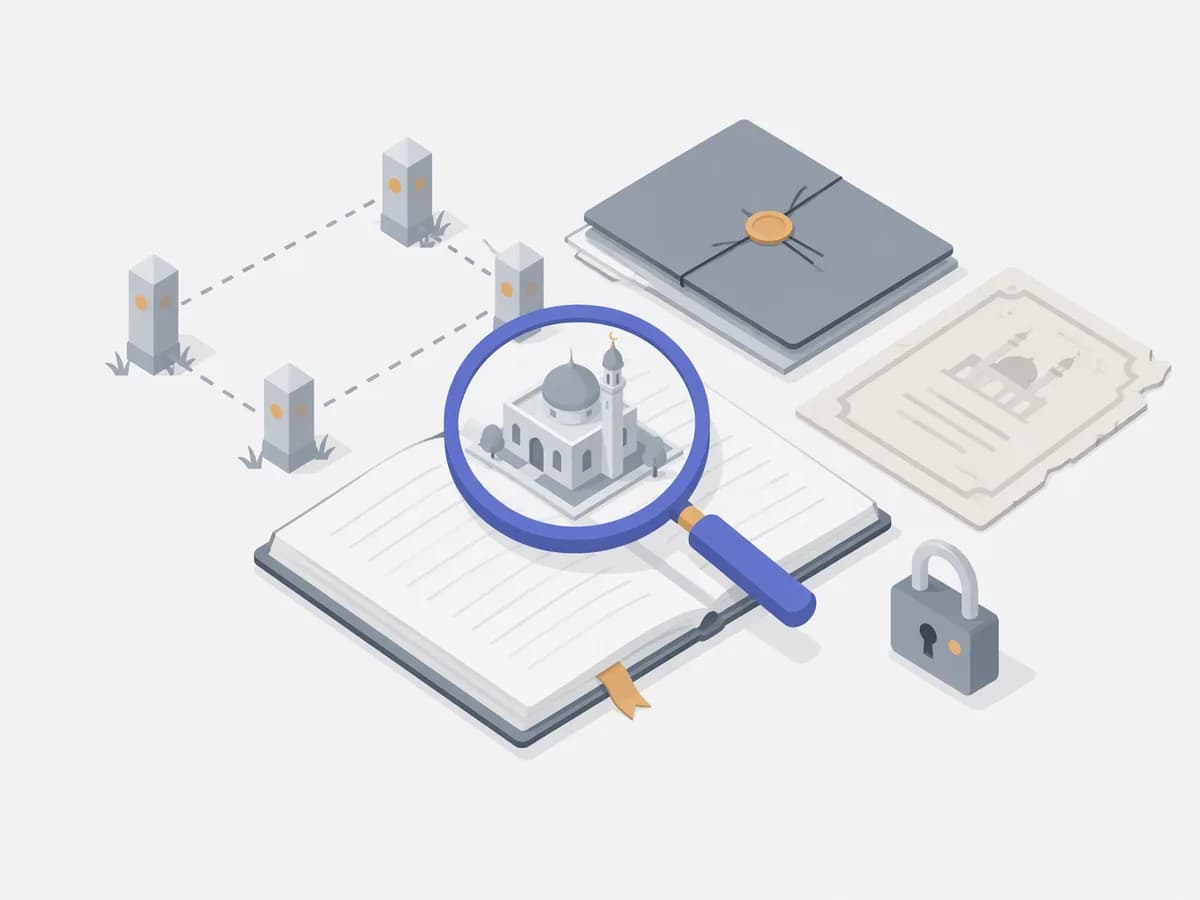
Land Near a Mosque or Dargah in 2026: Waqf Title Risk, Settled and Unsettled
What the Supreme Court's 2025 interim order stayed and left standing under the Waqf Amendment Act, and how to test waqf-adjacent land before you buy or lend.
Who this affects
Must read
Read this if you are buying, lending on, or doing title due diligence for land near a mosque, dargah, graveyard or similar site.
- Buyers
You must check whether land is deed-based waqf or a waqf-by-user claim and treat Collector tags as currently void.
- Lenders
Lenders should verify waqf status type and ignore any provisional Collector tagging as it is stayed by the Supreme Court.
- Lawyers & registrars
Title examiners must distinguish registered waqf from waqf-by-user claims and flag stayed Collector proclamations.
- Developers
Due diligence near religious sites needs extra checks but existing waqf-by-user protections are procedural, not final.
Signals in this story
- Political
- Financial
- Legal
- Regulatory
- Local
Legal signal is strongest: the Supreme Court's interim order stayed the Collector's power while upholding deletion of waqf-by-user prospectively.
Take a property close to a mosque, dargah, graveyard or any parcel with a record of community religious use. Today, one question there carries more title risk than two years ago. Is any part of the land waqf, and if its status is disputed, who decides it in the meantime? In September 2025 the Supreme Court passed an interim order on the Waqf (Amendment) Act, 2025. It changed the answer for some parcels and left others exactly as they were, and the constitutional challenge itself is still pending. This mix makes waqf-adjacent land one of the most confusing live title-risk questions as 2026 begins.
We stay with the legal and title-risk mechanics only. They are the earlier rules, the changes the 2025 Amendment Act sought, the parts the Supreme Court has and has not stayed, and what a buyer or lender should test before treating waqf-adjacent land as clear.
Summary: the settled and the unsettled
Settled in 2019: if someone says land is "waqf by user" (made waqf by long, continuous religious use and no formal deed), there must be a genuine evidentiary trail of possession and use. Community belief or oral tradition alone, with no documents or proof of possession, does not establish it. The Supreme Court said so in the Ayodhya title ruling.
Open since September 2025: under the Waqf (Amendment) Act, 2025, "waqf by user" can no longer create new waqf status, and District Collectors may provisionally mark disputed waqf land as government property while an inquiry runs. The Supreme Court's interim order left the removal of prospective waqf-by-user in place, but stayed the Collector's power to tag disputed land as government property on his own, which is now void. Registered, existing waqf-by-user properties cannot be dispossessed while the case is pending. Nothing here is final, because the challenge to the constitutionality of the 2025 Act is still before the Court.
For a title report: waqf-adjacent land is neither clear by default nor tainted by default. Work out which of these categories the specific parcel belongs to, since each carries its own risk.
Waqf by user and why a title chain cares
Under Muslim law, a waqf is property permanently dedicated to a religious, pious or charitable end. Ownership is regarded as resting in God after creation, the property is run by a mutawalli (caretaker) or a State Waqf Board, and in general it cannot be sold, gifted or mortgaged like ordinary private property. Most waqfs arise by an express deed. "Waqf by user" works differently. It treats land as waqf because it has been openly and continuously used for a religious or charitable purpose over a long time, such as a mosque, graveyard or dargah that has served as one for generations, with no founding paper that anyone can produce now.
A title examiner needs to keep the two apart. A waqf made by deed can be checked like any registered instrument. A waqf-by-user claim cannot, because it depends on evidence of past use, which may surface late, be pressed for convenience, or be valid yet hard to prove either way. Whatever the current sale deed says, land beside a religious structure, or with a historical link to one, always runs some chance that some or all of it will be claimed as waqf by user.
What the Supreme Court has already said on proof of waqf by user
The leading precedent pre-dates the 2025 dispute. M. Siddiq (D) Thr. Lrs. v. Mahant Suresh Das, the Ayodhya title case, was decided by a five-judge Constitution Bench on 9 November 2019. One issue was whether the disputed site counted as waqf by user. The Court held the evidence insufficient. It noted a large gap in evidence for the years from 1528 to 1857 and found that continuous, exclusive religious use over that span was not shown to its satisfaction.
The working principle for title purposes: a waqf-by-user claim needs a real evidentiary trail of continuous religious use, and long-held community belief is not enough. A bare assertion without documents or proof of possession does not, alone, cloud an otherwise clean title. The 2019 holding is the base on which the 2025 Amendment Act and the interim order both rest, and it remains good law.
The changes the Waqf (Amendment) Act, 2025 attempted
The Act made several changes. Two bear directly on title risk. One, it removed "waqf by user" as a valid way of creating new waqf status from now on, so that land could no longer become waqf simply by showing long religious use, and only recognized, documented modes would count after the Act's commencement. Two, it empowered District Collectors to treat disputed waqf land provisionally as government property while an inquiry into a rival claim was pending. In effect, a Collector could turn a contested parcel's status around before any tribunal or court had decided the underlying dispute.
A cap on non-Muslim members of Waqf Boards and the Central Waqf Council was also part of the Act. It concerns governance, has no bearing on title risk, and is left out here.
What the September 2025 interim order stayed, and what stayed in force
On 15 September 2025, Chief Justice B.R. Gavai and Justice Augustine George Masih sat as a bench and passed In Re: Waqf (Amendment) Act, 2025. They declined to stay the Act as a whole, but stayed two provisions until the final hearing:
- The condition that a person be a "practising Muslim for five years" before creating a new waqf. No mechanism exists to decide if a person meets it, the Court noted, so it stayed the condition pending workable guidelines from the State.
- The District Collector's power to tag disputed waqf property as government property by himself during an inquiry. The Court called this arbitrary and a separation-of-powers problem, as disputes over the status of property belong before tribunals and courts and not to an executive officer's provisional ruling. Disputed waqf land keeps its present status and cannot be taken from its holders while an inquiry is on. This assurance had been given earlier, in April 2025, for existing "waqf by user" properties, and the September order repeated it.
Not stayed: the removal of "waqf by user" as a way to create new waqf status from now on. That change stands today.
The outcome is split. Registered waqf-by-user land that is already recognized is shielded from being redesignated or seized while the dispute continues. A Collector, however, cannot at present convert a disputed parcel into "government property" on his own initiative, because that executive power is void for the time being. Neither position is the Court's last word, since the constitutional validity of the Act itself awaits a final hearing.
A myth to drop: "After the Waqf Amendment Act, disputed land near a mosque is government property"
The interim order says almost the opposite. A District Collector's power to convert disputed land into "government property" during an inquiry is exactly what the Supreme Court stayed in September 2025. A declaration of that kind has no legal effect for now, and if one appears in a title search, count it as void until the Court rules and not as a settled reclassification.
The reverse belief is also false. Registered waqf-by-user land is not now "unlimited" and is not safe from every challenge. What it has is narrower and procedural: no dispossession while the inquiry is pending. It is not a final finding that the underlying waqf claim holds.
Checks for buyers and lenders near waqf-claimed land
- What is the waqf status founded on: a registered deed, or a claim of "waqf by user"? · Reason: Waqf Board records can confirm a deed-based waqf, while a user-based claim must bring its own evidence (Ayodhya, 2019)
- Has a District Collector placed any "provisional government property" tag on this parcel or a neighbouring one? · Reason: The September 2025 interim order stays that power, so treat any such tag as void and not decisive
- Is the property (or a religious structure next to it) named in any pending Waqf Tribunal or civil case? · Reason: It shows whether the parcel sits inside a live dispute governed by the interim order
- When did the waqf-by-user claim arise, before or after the 2025 Amendment Act began to apply? · Reason: No stay covers the removal of prospective waqf-by-user recognition, so a user-only claim made after commencement is much harder to sustain
- Does the chain show private ownership without a break, and is there no waqf entry in revenue or Waqf Board records? · Reason: This is the best case, since no waqf claim, current or past, touches the parcel
No single check replaces an independent title search that traces the whole chain. These are the waqf-specific layer over the ordinary chain-of-title, encumbrance and registration checks that every purchase should have. For that wider review, read our guide to reading a sale deed clause by clause, before you accept any registered document as proof of clean title.
The road ahead
What the Supreme Court gave in September 2025 is an interim order and no final judgment. The constitutional challenge to the Waqf (Amendment) Act, 2025 continues, and the final ruling may uphold the Act as amended, strike down further provisions, or alter present protections. Waqf-adjacent title risk is one of several property-law questions that the Supreme Court has open at the same time. For the rest, see our roundup of six live Supreme Court battles that affect property titles in 2026. Until the Court disposes of the case, a legal opinion on any land connected with a mosque, dargah, graveyard or comparable community site must list the waqf question as unresolved and check it on its own. It does not close when the sale deed is registered, since registration does not prove ownership of any property, waqf-adjacent or not.
A manual review easily misses risks that are layered and depend on facts: a Collector's tag that is actually void, a user claim made after the cutoff, a Tribunal case that casual due diligence never reached. LegiScore's automated title search looks for waqf-linked entries, pending Tribunal references and Collector orders across a property's whole record, and not merely the current sale deed. Run a check at legiscore.in before you close.
Frequently asked questions
- Does a mosque or graveyard near my property make my land waqf by default?
- No, since nearness is not proof. Waqf by user must be shown by real evidence of continuous religious use of that particular land, a bar set by the Supreme Court in its 2019 Ayodhya ruling and still in force.
- May I still buy land that a District Collector tagged as "government property" during a waqf inquiry?
- Treat it as high-risk in every case. Since September 2025 the Collector's power to make such a tag has been stayed, so the tag carries no legal force now. Yet the dispute behind the inquiry is alive, and the Supreme Court's final ruling may reshape the framework once more.
- Is it safe to deal near registered waqf-by-user land?
- During the pending case such land cannot be taken from its holders. That is real but limited protection. There is no final finding that the waqf claim holds, and the chain of title around it still needs checking on its own.
- Is it possible for new land to become "waqf by user" now?
- The 2025 Amendment Act took that route away for new waqf status, and the interim order left the removal in force. A fresh waqf-by-user claim after the Act took effect must clear a much higher bar than one already recognized.
- What do I do if my title search flags a waqf-adjacent entry?
- Find out which kind of claim you face: a registered deed, a historical user claim or a Collector tag. Then check if it came before or after the 2025 Amendment Act and if a Tribunal or court case is pending on it. Each of these changes the risk.
- When will the matter be finally decided?
- As of writing, the Supreme Court has announced no date for the final hearing on whether the Waqf (Amendment) Act, 2025 is constitutional. Until then, regard the interim position as provisional: the deletion of prospective waqf-by-user stands, the Collector's tagging power is stayed, and existing waqf-by-user land is protected until the final hearing. Check it again before any deal on waqf-adjacent land closes. This is general information about where Indian property and waqf law stand today and not advice on any specific property. An interim order in a pending case can be revised before the final judgment. A qualified advocate should be consulted before you act on it in a real transaction.
General information only. This is not legal advice; consult a qualified property lawyer for your situation.
Need a property report?
Get a comprehensive title search report powered by LegiScore.
Powered by LegiScore Trusted by homebuyers, lawyers and lenders
Related reading

Pending Case on the Property You Want? What Lis Pendens Means for Indian Buyers
Expert Views 15 Feb 2026
18 min read
Worth a read for Buyers, Lenders

Elders' Gift Deeds: When a Tribunal Can Cancel the Transfer Years Later
Expert Views 24 Jul 2026
10 min read
Must read for Buyers, Owners

For Most Buyers, the Risk Is Not the Price but the Title
Expert Views 10 Oct 2026
4 min read
Worth a read for Buyers, Lawyers & registrars

A Daughter's Coparcenary Share After 2005, and the Old Family Partition That Can Reverse a Sale
Expert Views 24 Jul 2026
11 min read
Must read for Buyers, Owners