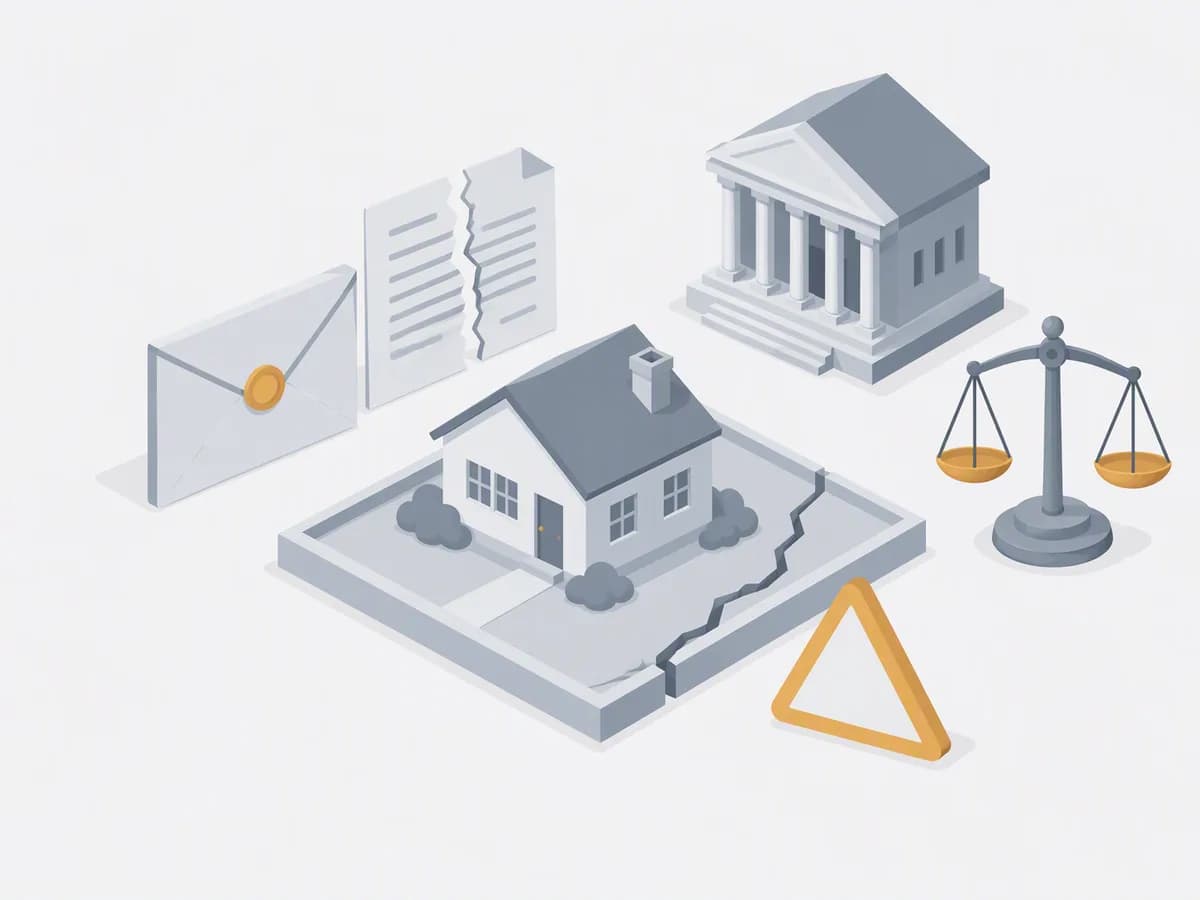
Disputed Title After You Bought: Remedies, Deadlines and Costs
Five legal routes if your property's title is challenged: declaration suit, specific performance, injunction, mediation and a BNS 318(4) fraud complaint, plus the limitation rules.
Who this affects
Must read
Read this if you bought a property and later found title defects, competing claims, or concealed litigation.
- Buyers
If you bought property that later shows a title dispute you must act quickly: remedies and limitation periods affect your case.
- Owners
Owners who discover competing claims or defects get legal remedies but strength weakens with delay.
- Lawyers & registrars
Guidance on which remedies, limitation periods and recent Supreme Court rulings affect cases and filings.
Signals in this story
- Political
- Financial
- Legal
- Regulatory
- Local
Strong legal/regulatory signals: recent Supreme Court rulings, Limitation Act rules and a new fraud provision (BNS 318(4)) change remedies and timelines.
Learning that the property you just bought has a disputed title is a nightmare. It may be a pending court case, competing ownership claims or a legal issue the seller never mentioned, and in each case your investment is at serious risk. You still have options.
Several remedies are open to a buyer with a title defect in India, under the Transfer of Property Act, 1882 and assorted civil and criminal provisions. We explain the options, the process, the likely cost and, most of all, how to avoid ending up here.
“In short (2026): a title dispute that appears after purchase still leaves you with remedies. You can bring a declaratory suit (Section 34, Specific Relief Act), seek specific performance, ask for an injunction to freeze any further sale, use court-annexed mediation, or lodge a criminal complaint for fraud (Section 318(4) BNS, which replaced IPC 420 on 1 July 2024). Limitation trips up buyers more than anything else. A suit solely for a declaration of title must be filed within 3 years (Article 58), whereas one that also asks for possession gets 12 years (Article 65), as settled by the Supreme Court in N. Thajudeen v. TN Khadi Board (2024) and Mallavva v. Kalamma (2024). The 2025 caution stands too: a registered sale deed does not, taken alone, prove ownership (K. Gopi; Mahnoor Fatima Imran), and no registration can supply the title that a seller never had. All remedies weaken as time passes.”
How a buyer ends up with a disputed title
To understand the remedies, first see how these disputes begin.
The usual scenarios are:
- Hidden litigation: a pending court case over the property was not mentioned at the time of sale
- Rival claimants: legal heirs, co-owners or earlier owners turn up with competing claims
- Forged papers: the sale deed, power of attorney or title documents were fabricated
- Illegal construction or land use violations: zoning laws are broken, or the building lacks approvals
- Unpaid dues or encumbrances: loans, mortgages or government dues are still attached
- Benami purchase: the property was bought in another person's name to evade tax
NITI Aayog and court-backlog studies are widely cited as showing that property disputes make up nearly two-thirds of India's pending civil litigation, with an average of 5-7 years to resolve a case. Verifying before you buy is therefore essential.
When a title dispute comes to light after purchase
Such disputes usually surface in one of two ways.
Early discovery (within 6-12 months):
- A new claimant sues to challenge your ownership
- A bank turns down your loan application because of title defects
- The municipality sends a notice for illegal construction
- A lis pendens notice shows up in property records
Late discovery (1-3 years on):
- On resale, the buyer's lawyer spots title problems
- The heirs of an earlier owner contest the sale
- A government acquisition begins and exposes gaps in ownership
- An encumbrance certificate reveals mortgages or attachments that no one disclosed
The timing of discovery matters a great deal to your options and to the strength of your case.
Your rights as a bona fide purchaser
Indian law gives solid protection to bona fide purchasers, who bought in good faith with no knowledge of defects.
The main protections:
Section 41, Transfer of Property Act: shields a buyer who bought without notice of defects in the seller's title, if the transfer was for consideration.
Part performance (Section 53A): having paid and taken possession, you hold equitable rights even where title is defective, though the 2001 amendment limits this to cases in which the agreement to sell is registered.
The lis pendens exception: you are protected if the dispute began after your registration. If litigation was already pending when you bought, your claim is much weaker.
To qualify as bona fide, you must show:
- You did reasonable due diligence
- You had no actual or constructive knowledge of title defects
- You paid fair market value
- You took physical possession
Courts hold consistently that ignorance of a defect does not automatically make you bona fide. You must show that you took reasonable steps to verify title.
A warning from 2025: a registered deed is not a title. The Supreme Court cut back the protection of buying in good faith and registering. K. Gopi v. Sub-Registrar (2025 INSC 462) held that a registered sale deed shows only that a transaction occurred and is no proof that the seller owned what he sold. Mahnoor Fatima Imran v. Visweswara Infrastructure (2025 INSC 646) held that a later registered deed founded on a defective or unregistered earlier link passes no title, in line with nemo dat quod non habet, the rule that nobody can transfer better title than he has. Section 41 TPA still protects a buyer, but within narrow limits: the true owner must have consented to the seller holding himself out as owner, and you must prove reasonable care. Where the seller had no title, Section 43 TPA ("feeding the estoppel") gives you any title that later reaches him, and you can claim money from him. The receipt of registration offers no shield alone.
Route 1: civil suit for declaration of title
This is the usual remedy when your ownership is challenged.
Meaning: a declaratory suit under Section 34 of the Specific Relief Act, 1963, in which the court is asked to declare you the rightful owner.
Best suited when:
- Someone else claims your property
- Title documents show conflicting entries on ownership
- You need the court to confirm your title before you sell
Steps:
- File the suit in the civil court with territorial jurisdiction
- Produce all title documents, the sale deed and proof of possession
- The court examines the entire title chain, typically 30 years
- The defendant presents counter-claims and evidence
- The court declares who the rightful owner is
Duration: on average 3-5 years in district courts, and 1-2 years if fast-tracked
Fees: ₹50,000-₹3,00,000 in legal fees, plus court fees at 2-3% of property value (ad valorem)
Limitation rule: for a suit only to declare title, file within 3 years of denial of your right (Article 58, Limitation Act). If you are out of possession and want it recovered, Article 65 allows 12 years from when the other side's possession became adverse, as the Supreme Court settled in Thajudeen and Mallavva. Practical advice: after losing possession, sue for declaration and possession together to secure the longer 12-year period.
Factors that help:
- Documents that show an unbroken title chain
- Physical possession since the purchase
- Property tax paid regularly in your name
- Witnesses to the transaction
Route 2: specific performance
If the title defect came from the seller's failure to give the clear title promised, you can sue for specific performance.
Meaning: under Sections 10-20 of the Specific Relief Act, you can compel the seller to honour the contractual duty to give marketable title.
Best suited when:
- The sale agreement expressly guaranteed clear title
- The seller knew of the defects and hid them
- You want to keep the property and not cancel the sale
Steps:
- File the specific performance suit within 3 years of the breach
- Prove that a valid sale agreement existed
- Show that you did your part: paid the money and were ready to complete
- Demonstrate the seller's breach, meaning the title defects were not cleared
- The court orders the seller to fix the title or face penalties
Orders the court can make:
- The seller to clear title defects at their own cost
- The seller to obtain the necessary consents or approvals
- The seller to remove encumbrances before completing the sale
- Compensation for losses if specific performance is not feasible
Duration: 2-4 years, depending on complexity
Fees: ₹75,000-₹5,00,000 in legal fees
Route 3: injunction against further sale
Where the property may be sold to third parties during the dispute, ask for an injunction.
Meaning: a court order, temporary or permanent, under Order 39 Rules 1-2 CPC, that stops the seller or other claimants from selling or transferring the property.
Best suited when:
- There is a risk of sale to innocent third parties
- The seller is trying to create several sale deeds
- Status quo must be maintained during the litigation
Types:
Temporary injunction: granted at once to preserve the property's status until the final hearing, and valid until the case ends or the order is revoked.
Permanent injunction: the final order after full trial, which restrains specified acts permanently.
Steps:
- File the injunction application along with the main suit
- Show a prima facie case, meaning preliminary evidence of your claim
- Prove balance of convenience: you would suffer more if the injunction is refused
- Show irreparable injury, where money cannot compensate
- In urgent cases the court may grant it ex-parte, without hearing the defendant
Duration: a temporary injunction in 1-4 weeks, and a permanent one after the main case ends
Fees: ₹25,000-₹1,50,000
Important: violating an injunction is contempt of court and punishable with imprisonment.
Route 4: mediation and settlement
Not every dispute needs long litigation. Court-annexed mediation is faster and less adversarial.
Meaning: a structured negotiation in which a neutral mediator helps the parties reach a solution acceptable to all.
Best suited when:
- Both sides are willing to compromise
- The dispute involves family members or people known to each other
- A quick outcome matters more than complete vindication
- Saving cost is important
Benefits:
- Speed: 2-6 months where court takes 3-5 years
- Cost: ₹15,000-₹75,000 against ₹2-10 lakhs for litigation
- Confidentiality: terms stay private
- Flexibility: solutions that go beyond court orders
- Relationships: less hostile than a lawsuit
Stages:
- The parties agree to mediation, voluntarily or by court referral
- A neutral mediator is chosen, often a retired judge or senior advocate
- Joint and separate sessions bring out each side's position
- Settlement options are explored
- A settlement agreement is drafted
- It goes to the court so that it becomes a decree and is legally enforceable
Typical settlements:
- The buyer keeps the property and compensates the rival claimant
- The property is divided among the claimants
- The buyer returns the property and the seller refunds the money with interest
- A buyout by a third party is arranged
Pre-institution mediation is mandatory under the Commercial Courts Act, 2015 for commercial property disputes worth more than ₹3 lakhs.
Route 5: criminal complaint for fraud
When the title dispute stems from deliberate fraud, deception or forgery, criminal remedies exist.
Meaning: an FIR or criminal complaint under the Bharatiya Nyaya Sanhita, 2023 (BNS), which has replaced the Indian Penal Code since 1 July 2024. The old IPC still governs offences committed before that date:
- BNS Section 318(4) (earlier IPC 420) deals with cheating and dishonestly inducing delivery of property, with a maximum of 7 years
- BNS Section 338 (earlier IPC 467) covers forging a valuable security, will or transfer deed, and can bring up to life imprisonment
- BNS Section 336(3) (earlier IPC 468) is forgery done for the purpose of cheating
- BNS Section 340(2) (earlier IPC 471) punishes using a forged document as if genuine
- BNS Section 61(2) (earlier IPC 120B) is criminal conspiracy
Best suited when:
- The seller knowingly sold a property with disputed title
- Signatures were forged or documents fabricated
- Impersonation or identity fraud occurred
- Several buyers were cheated over one property
Steps:
- File an FIR at the local police station, ideally the economic offences wing
- Police investigate and file a charge sheet
- The case goes to trial in a criminal court
- On conviction the seller faces imprisonment of up to 7 years and fines
Benefits:
- Strong pressure on a fraudulent seller to settle
- Police investigation preserves evidence
- Money may be refunded during the trial
- A criminal conviction strengthens your civil case
Drawbacks:
- Criminal proceedings do not directly decide title disputes
- A trial takes 3-7 years
- A parallel civil suit is needed to recover the property
- Bail may leave the accused free during the trial
Practical tip: file both civil and criminal cases together. The civil case settles who owns the property, and the criminal case punishes the fraud and deters repeats.
Time and cost of resolving a title dispute
Realistic timelines and costs help you decide with open eyes.
Side-by-side comparison:
- Mediation · Time taken: roughly 2-6 months · Lawyer: ₹15,000-75,000 · Court fee: ₹5,000-20,000 · Chance of success: 65-70%
- Temporary injunction · Duration: 1-4 weeks · Lawyer: ₹25,000-1,00,000 · Court fee: ₹2,000-10,000 · Chance of success: 50-60%
- Declaration suit · Duration: 3-5 years · Lawyer: ₹50,000-3,00,000 · Court fee: 2-3% of property value · Chance of success: 40-50%
- Specific performance · Duration: 2-4 years · Lawyer: ₹75,000-5,00,000 · Court fee: 3-5% of property value · Chance of success: 35-45%
- Criminal case · Duration: 3-7 years · Lawyer: ₹1,00,000-10,00,000 · Court fee: ₹5,000-25,000 · Chance of success: 25-35% for a conviction
Extra costs to expect:
- Stamp duty, if documents must be re-registered
- Upkeep during litigation, such as taxes and maintenance
- Lost opportunity, since you cannot sell or mortgage during the dispute
- Stress and time
- Expert witness fees for engineers, valuers and document examiners
Commercial Courts Act benefit: commercial-use property disputes above ₹3 lakhs filed in Commercial Courts have statutory timelines, with disposal in many states within 6 months to 1 year.
Better to prevent: verify before you buy
Thorough verification before purchase is the best defense against title disputes.
Key checks:
1. Title chain verification:
- Check that ownership runs unbroken for at least 30 years
- Confirm that every transfer deed was properly executed and registered
- Verify who all the earlier owners were
- Rule out gaps or unexplained jumps in ownership
2. Encumbrance certificate check:
- Get a 30-year EC from the sub-registrar office
- Confirm no mortgages, liens or pending sales
- Look for court attachments or revenue dues
3. Pending litigation search:
- Search district court and high court records
- Look for lis pendens notices
- Confirm no insolvency or SARFAESI proceedings
4. Physical verification:
- Match boundaries with revenue records
- Look for unauthorized construction or encroachments
- Check that possession fits the ownership documents
- Ask neighbors about the property's history
5. Legal opinion:
- Engage a property lawyer to review all documents
- Get a written opinion on marketability of title
- Identify red flags and risk areas
Why manual checks often fall short:
- It is slow: 4-8 weeks for a thorough check
- Humans make errors in analyzing documents
- Court record searches are incomplete
- Government portals give outdated information
- There is no systematic risk scoring
Technology-enabled solutions such as LegiScore offer a big advantage here.
How LegiScore guards against title dispute risk
LegiScore is India's first AI-powered property verification platform, and it addresses title dispute risk end to end.
Detecting title dispute risk:
1. Litigation risk analysis:
- Automatic searches across 18,000+ district and high courts
- Picks up pending suits, criminal cases and execution proceedings
- Flags lis pendens notices and property attachments
- Spans civil, criminal, revenue and family courts
2. Title chain verification:
- AI reads the documents in a 30-year title chain
- Detects gaps, forgeries and irregular transfers
- Compares revenue records with encumbrance certificates
- Marks properties that were sold more than once or whose ownership is contested
3. Encumbrance risk scoring:
- Uncovers undisclosed mortgages, liens and charges
- Spots SARFAESI notices and bank attachments
- Checks revenue dues and property tax arrears
- Flags hidden encumbrances that ordinary checks miss
4. Compliance verification:
- Sanctioned building plans and occupancy certificates
- Breaches of land use and unauthorized construction
- RERA registration for projects still being built
- Environmental clearances, where they apply
5. LPS Rating (AAA to C):
- Merges every risk factor into one credit-style rating
- AAA signals the lowest dispute risk, and C the highest
- Scores eight LPS pillars in detail, among them Ownership History, Loans & Charges, Court Cases, Approvals & Permits and Market Conditions
- Gives practical advice on reducing risk
Who gains:
For property buyers:
- Avoid buying disputed properties altogether
- Negotiate better prices where risks are identified
- Decide with full visibility of risk
For lawyers:
- Automate routine verification tasks
- Concentrate on complex legal analysis and advice
- Deliver legal opinions to clients faster
For banks and financial institutions:
- Screen loan applications for title risk
- Reduce NPAs arising from disputed collateral
- Make faster loan decisions
See your property's legal health and obtain a full title and dispute-risk opinion before you commit: order your LegiScore report.
Frequently asked questions
- Is it possible to get my money back after buying a property with disputed title?
- Yes. Section 27 of the Specific Relief Act lets you sue to rescind the contract and get a refund, but you must prove that the seller concealed material facts or breached contractual warranties. Courts generally order the whole price back with 6-9% annual interest, registration charges and costs. A buyer who took possession and used the property may see notional rent deducted. Allow 2-4 years. Separately, a criminal complaint for fraudulent misrepresentation under Section 318(4) BNS (cheating; it took over from IPC 420 on 1 July 2024) can back up the civil claim.
- I already paid stamp duty and registered. What now?
- Registration does not by itself validate a defective title. A civil court challenge to the sale remains possible, and a successful one can cancel the registration. Stamp duty already paid is generally not refunded. Your remedies: (1) a suit to cancel the sale deed and refund the price, (2) specific performance to compel the seller to clear title defects, or (3) a declaratory suit establishing your ownership despite defects. Make your case on being a bona fide purchaser without knowledge of defects. Courts regard registration as evidence of the transaction and do not treat it as conclusive proof of valid title.
- What proves that I am a bona fide purchaser without notice of defects?
- Present evidence showing that: (1) you did reasonable due diligence, such as an encumbrance certificate, a legal opinion and physical verification records; (2) you had no actual knowledge of defects, with nothing mentioned in the sale agreement and positive representations made by the seller; (3) you paid fair market value through banking channels, with receipts; (4) you took immediate physical possession, with witnesses; and (5) you promptly began paying property taxes and utility bills. Courts ask whether a reasonably prudent person would have found the defects. Claiming ignorance is not enough, so show active efforts to verify.
- Could the original owner recover the property if my seller's title was invalid?
- Yes, the original owner can take it back if your seller's title was void, under Section 6 of the Specific Relief Act, because of "nemo dat quod non habet" (no one gives what he does not have). You still have protections. A bona fide purchaser can claim compensation from the fraudulent seller, can be reimbursed for improvements and may hold possession until paid for them (lien). A third-party suit joining the original owner and your seller protects you. The original owner must prove title and that it never validly passed.
- Does title insurance exist in India to cover such disputes?
- Title insurance is sold in India but is not widely taken up. Few insurers offer it, charging premiums of 0.5-1% of property value, and it pays legal costs and compensation if covered title defects appear after purchase. Its exclusions are substantial: disputes known when you bought, government acquisitions, environmental violations, flaws in the property survey, and claims by parties in possession. It also reacts after the event. Proactive verification, for instance on a platform like LegiScore, is the better route because comprehensive pre-purchase risk scoring keeps you from buying disputed property at all.
- After how long can I assume a property is free of disputes?
- There is no "safe period" in India after which disputes cannot arise. Limitation depends on what you seek. A suit just to declare title has 3 years (Article 58); a suit for declaration plus recovery of possession has 12 years from when possession became adverse (Article 65), as reaffirmed in Thajudeen (2024) and Mallavva v. Kalamma (2024). Agencies of government often have longer periods to recover public land. Risk reduces over time when you keep continuous, uninterrupted possession, pay property taxes in your name, improve the property visibly and declare your ownership openly. Twelve years of peaceful possession strengthens an adverse possession claim. Prevention through pre-purchase verification is still far better than waiting.
- Is a registered sale deed a protection if my title is challenged?
- Not alone. Twice in 2025 the Supreme Court separated registration from ownership. K. Gopi v. Sub-Registrar (2025 INSC 462): a registered deed records a transaction and does not establish that the seller owned the property. Mahnoor Fatima Imran v. Visweswara Infrastructure (2025 INSC 646): a later registered deed cannot mend an earlier link that was broken or unregistered (nemo dat quod non habet). Even a fully registered property may therefore carry a fatal defect. Your actual protection lies in a title chain verified clean for 30 years, bona fide purchaser status under Section 41 TPA and, where the seller lacked title, Section 43 TPA together with a claim against the seller.
- How soon must I act after finding the dispute?
- Do not wait. Each remedy loses strength with time. It is hardest to get an injunction after the property has been resold, evidence and witnesses fade, and limitation may run out. After a loss of possession, Article 65 gives 12 years from when the opposing possession turned adverse, but treat that as an outer limit. Start with an injunction that freezes further sale, then file for declaration with possession. Ahead of either, commission a full title search and a written legal opinion, so the pleadings address the real defect. A LegiScore report can identify precisely what is wrong in the chain.
General information only. This is not legal advice; consult a qualified property lawyer for your situation.
Need a property report?
Get a comprehensive title search report powered by LegiScore.
Powered by LegiScore Trusted by homebuyers, lawyers and lenders
Related reading
Seller Has Deeds Only From 1998 but the Bank Wants 30 Years: Your Options
Property Risks 30 Sept 2026
14 min read
Worth a read for Owners, Buyers

Seller Got the Property Under a Will: Must You Insist on Probate?
Property Risks 16 Sept 2026
12 min read
Must read for Buyers, Sellers
Agricultural land conversion in Gujarat: plot buyer risks
Property Risks 18 Oct 2026
7 min read
Worth a read for Buyers, Developers

Seven Signs a Property Document May Not Be What It Seems
Property Risks 13 Oct 2026
6 min read
Worth a read for Buyers, Lawyers & registrars